|
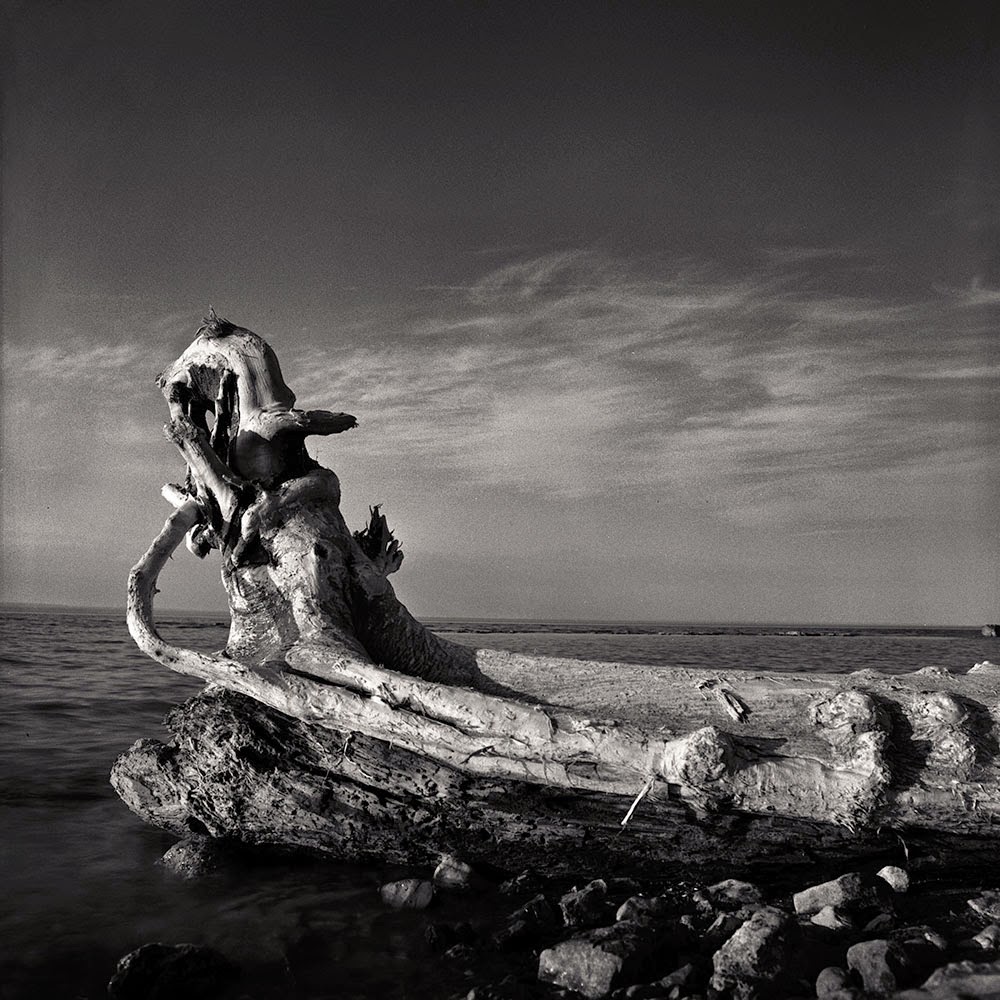
| Is that dark speck out in the water another pinhole in the negative? Thankfully no, close inspection reveals it is just a duck. |
This is a progress report of sorts on the situation I described a couple of episodes back in "Curse of the Dragon". That title refers to one subject, a driftwood log that reminded me of the dragon figurehead on a Norse longboat, of which nearly every image I took seemed to result in a negative plagued to some degree or other by pinholes in the negative, resulting in dark spots on the positive image. It wasn't the subject of course, just a bit of bad luck that somehow on three separate rolls of film that contained images of that log nearly all the spots wound up on those negatives.
Now if the only thing I was ever going to do with these negatives was scan them and put them up on the internet, or even if I printed from scanned files, this would be little more than an annoyance. These black spots are no more difficult to remove in Photoshop than are dust spots, the near inevitability of which I've reconciled with long ago. For me however a finished image is nothing short of a traditional silver print. With Photoshop taken out of the equation retouching dust spots is done on the prints directly using special retouch dyes and a #000 brush. This of course can only make a light spot darker and there is some risk of ruining the print, especially if you're out of practice. Retouching the dark spots that result from pinholes in the negative requires much more drastic measures and a much greater risk of botching the job. After spending hours getting all the printing details down, toning, archival washing and so on (retouching has to come after all of this) the risk of that kind of heartbreak is something I consider unacceptable. Finding solution to this out of the blue problem is therefore a necessity.
A quick review or those of you who haven't read the first part, pinholes in photographic negatives can be caused either by air-bells, which are simply tiny bubbles of air that cling to the surface of the film preventing developer from reaching the emulsion at that spot, or chemical reactions suddenly releasing little gas bubbles that blow tiny holes in the emulsion. Think of the fizz you get when you mix baking soda and vinegar. Developers contain an alkali very similar to baking soda (I start with baking soda to make the alkali for my home mixed developers) and the acetic acid in most stop baths essentially is vinegar. It seems pretty safe to eliminate cause number two though - I use plain water in between developer and fix.
So air-bells are almost certainly the culprit, but what is behind their sudden appearance in such numbers? To be sure the occasional stray pinhole has found its way onto my negatives from time to time, but never before has an image looked like it had been sprayed with a tommy-gun. My standard practice when developing roll film includes two preventative measures - pre-soaking the film in plain water before starting with the developer and giving the tank several firm raps on the counter after every agitation cycle to shake off any bubbles that form. Many darkroom workers suggest a single rap only after the developer is added and say they find a pre-soak to be a waste of time so I always thought that if anything I was being overly cautious. To be suffering from them anyway just seems unjust.
Something In The Water?
 I had two suspects in mind. The first was a possible change in the water. Part of the reason I always seem able to find new images along the same few kilometres of beach is the fact the lake is an ever changing mistress. Well that same changing lake that figures in so many of my images also happens to be the source of the water those images are developed in. It never seemed to be a problem. The water quality where I live is pretty good, we don't have hard water and our town water was rated the second best tasting water in Ontario. But the treatment and testing of tap water is done with a mind to human consumption, not consistent results in the darkroom. Distilled water is considered the gold standard when mixing photo chemistry. In areas where the tap water is less suitable for photo chemistry it is virtually mandatory. Even though I've never considered tap water to be a problem the one virtue distilled water has is that it's not subject to sudden changes and is the same anywhere you go. It isn't expense that's kept me from using but rather the dual inconveniences of having to store it and the fact it doesn't run hot and cold which can make getting it to a specific temperature an extra challenge at times.
Factor number two was the change I had made a month or so before from using the stainless steel tanks and reels that had been my standard for years to plastic Paterson tanks and reels. It seemed like a safe choice - Paterson has to be the most widely used daylight processing tank system by quite a stretch. The comparative advantages of plastic vs. stainless could (and very well might) be the subject of an episode on their own, but my reasons for doing so have less to do with versatility and ease of use than my accidental discovery that a problem with negatives showing more development along the edges of the film compared to the middle simply went away when I used them. For this reason I was hoping the water was the problem. I did not want the solution to the pinhole problem to require a return to uneven development I thought I had banished for good. It wasn't a severe problem, it just required some extra effort during printing to even things out, but it was a pain and sometimes even meant using an extra sheet of paper or two to get things right and I was glad to be rid of it.
 |
| My stainless steel tank and 120 reel on the left, and Paterson tank on the right along with a reel adjusted for 120/220 film. |
The Investigations Begin
Chosing to let hope lead I decided to stay with the Paterson tanks for now and see what happens with distilled water. I'm currently working with the Beutler formula as my standard developer, mixing the stock solution from scratch using distilled water. Now I would be diluting it for use with distilled water as well, rather than tap water which had always been my practice before. Just to be safe I also used distilled water for the pre-soak. For the remainder of the process tap water would be used as usual since I had no suspicions the problem might occur after development. Even as I was hanging the strip out to dry the result was obvious however as an unmissable clear spot appeared smack in the middle of a dense are of sky on one of the images. On the bright side it wasn't an image I would have wanted to print anyway and there weren't many pinholes besides this. In the grander scheme of things however this wouldn't do.Before reverting to the stainless tank however I decided to give one other idea a go - adding a few drops of the wetting agent (Photo Flo, LFN or what have you) to the pre-soak and the developer. Having run into one or two sources that recommend against this I was reluctant to try it, but the more I researched the more I found this was done a matter of course by more people than I had suspected. No matter, it still wasn't difficult to find pinholes.
I actually had to dig the stainless steel tank out, having stored it away thinking I might never have use for it again. It's back in it's old spot now though because from it emerged the first roll of film since the curse of the dragon began that did not contain pinholes. Some extra density along the edges, yes, but those can be dealt with.
Putting It All Together
Did I really have to deal with them though. I had a pretty good idea why negatives were coming out of the plastic tanks more evenly developed. Even when filled with chemistry they weren't really full. There was always a generous amount of air at the top so that when the tank was inverted there was room for things to slosh around, replacing exhausted developer with fresh more completely. With stainless tanks I have always been in the habit of mixing enough chemistry to allow me to see it above the top of the light trap in the lid - 475ml. It was more that the 450ml suggested, but it was somehow reassuring to see it, knowing there was no possibility anything inside wasn't completely immersed in chemistry. |
| Straight from the scanner this is typical of the results I often got with negatives developed in stainless steel tanks. Note how much brighter the sides are compared to the centre. |
It's only been one roll since I tried this but so far the answer is yes. The image at the top is from this roll. It came out as even as anything that's come out of the Paterson tank and pinhole free. It seems like it's the plastic tanks that will be headed to storage now, which is a shame really since it was the more complete system. The stainless system I have limits me to developing one roll at a time which can be quite a pain. I'll be travelling most of this week and anticipate returning with several rolls to process. On the bright side I like working with the stainless tanks. I find the process of loading the reels more foolproof than with the plastic and the tanks I have don't leak at all. For some reason every Paterson tank I have ever used dribbles a little chemistry every time they are inverted.
None of this is to suggest the Paterson or any other plastic reel and tank system are bound to give you the same results. If everyone had the results I got these products would have fallen off the market long ago. It's, what can I say, one of those things. Somewhere in the idiosyncrasies of the materials I use and the way I do things is the reason I had problems while countless others did not. Maybe someday I'll figure out what it is. The real bottom line is that if none of this happened I'd probably still be doing things the way I have for years thinking density variations were something I just had to live with.
Post Script
As I said I'll be travelling much of the upcoming week. The bad news is that leaves me without any significant time for any little extras like writing another blog entry so there will be no Golden Age of Silver next week. The good news is that I anticipate having at least a photo or two taken during my travels to talk about, and if for some reason I don't, well the reasons for that should be worth talking about for their own sake. At any rate, lets all agree to meet back here sometime in early June.