Showing posts with label developer. Show all posts

Tuesday, 30 June 2015

Simple Alchemy Supplemental - Beutler's Day Off

While the original article Simple Alchemy was intended as a small expose on the practice of mixing your own darkroom chemistry from raw ingredients a good deal was said about my favourite home-brewed concoction Beutler's developer. From the feedback I have received so far it seems a lot of the interest many of you had in it was about this formula itself. And so, even as the arrival of enough PMK Pyro developer to last me at least a year may see my stock of Beutler put into semi-retirement it seems a good time to add a few things that might be of practical value to anyone inclined to try it for themselves.

Willi Beutler published the formula for his namesake developer during the 1950s in response to the new fine grained, thin emulsion films that were beginning to appear on the market at the time. The idea was to create a reasonably dilute one shot developer that would exhaust in the regions around dense highlight areas while remaining more active in the thinner shadow portions of the negative, creating a compensating effect to counteract these newer film's higher contrast. At the same time the finer grain of these films made it unnecessary to create a solvency effect which reduces the appearance of grain but also has the effect of giving a mushier appearance to fine details. By avoiding this Beutler formulated his developer to favour high definition, or acutance, over reducing grain. As a bonus, by favouring development in the shadows where the telling signs of underexposure appear, while avoiding the density reducing solvency effect of fine-grain developers, the formula makes the most of true film speed, which is to say the natural ideal speed at which to shoot without "pushing".


The plan is just as valid with today's moderate to slow speed black and white films as it was sixty years ago. Beutler is used to maximum advantage with films of 125 ISO and below. This is not to say that its virtues are completely lost on faster films, but you're less likely to need the compensating effect at higher speeds and more likely to miss the grain reducing effect that even middle of the road developers like D76 give you.

While we're on the subject I should say here that it isn't really fair to call Beutler, or any other formula for that matter, a "high grain" developer. Grain is an inherent part of the film and a developer can only mask its appearance, making it less obvious. Developers that have a reputation for yielding grainy results (Rodinal is another one you may hear this about) simply don't incorporate any measures to do this. This isn't oversight, grain reduction typically comes at a price in terms of acutance and film speed. They don't boost the appearance of grain so much as show it to you like it is.

There is one small word of caution in order before we get into details on using Beutler. If you use this or any other developer containing Metol (this includes a host of common film and paper developers including D76 and Dektol) in such a way that your are in prolonged contact with the solution (such as tray developing sheet film) wearing gloves or other protective measures to prevent direct contact with the skin is recommended as develop an adverse skin reaction with prolonged and repeated contact with Metol, also known by its Kodak trade name Elon.

Beutler is prepared as two separate concentrates that are combined and diluted just prior to use, after which the used developer is discarded. Part A contains the sole developing agent Metol, and enough Sodium Sulfite to act as a preservative, In higher concentrations Sodium Sulfite acts as a solvent that can begin to dissolve the metallic silver that make up the image grain which is precisely the strategy employed by nearly all grain reducing developers. I'll also note that it is important not to confuse Sodium Sulfite with Sodium Sulfide, a nastier substance also used in photo chemistry. Part B contains Sodium Carbonate to create the alkali environment needed by every photographic developer I've ever heard of. The alkali causes the developer to oxidize much more rapidly once combined so keeping the two parts separate until just prior to use increases the shelf life dramatically. You may find Sodium Carbonate at the local supermarket, sold under its common name Washing Soda. There are plenty of photographers use supermarket Washing Soda when mixing up their developers, just be careful not to get the scented stuff. The final chemical used in both parts is water. (I wish it weren't the case that so many people are surprised to hear water referred to as a chemical, which it most certainly is.) Water quality can vary greatly depending on where you live, and hard water is always bad news in photo chemistry, so if in doubt distilled water is always a good choice and usually very cheap.

That said, here is the recipe for Beutler:

Solution A:
750ml Water (40-50oC)
10g Metol
50g Sodium Sulfite
Cold water to make 1L

Solution B:
750ml Water (40-50oC)
50g Sodium Carbonate (anhydrous)
Cold water to make 1L

Notes on preparation:

  • To make different quantities adjust all quantities in proportion equally
  • If using the monohydrate form of Sodium Carbonate multiply the quantity by 1.17
  • To prevent Sodium Carbonate from clumping into hard to dissolve crystals stir while adding it to water and do so gradually in a steady stream.

Usage

You may prepare any quantity of Beutler needed by combining and diluting the parts in any of the following proportions:

"Official" dilution: 1 part Soln A + 1 part Soln B + 8 parts water
Popular dilution: 1 part Soln A + 1 part Soln B + 10 parts water
The dilution I use: 1 part Soln A + 1 part Soln B + 12 parts water

The official dilution is what was recommended when the formula was first published though the popular dilution seems to be what is more commonly used these days. If you look up recommendations for using Beutler with your film on The Massive Dev Chart or elsewhere you may find recommendations for either or both of these dilutions. Do not use time/temperature recommendations for Neofin Blue assuming it's the same thing. While The Photographer's Formulary sells Beutler under the alternate name Neofin Blue, Neofin Blue proper is actually a completely different formula sold by Tetenal and the Massive Dev Chart's listings are for this product, Beutler is listed separately. I began using the higher 1+1+12 dilution because it's my completely arbitrary opinion that a compensating developer needs a good ten minutes in contact with the film to work properly and lesser dilutions weren't giving this to me with my favourite film. This works fine, makes it even cheaper to use and divides nice and evenly into the 420ml of solution I need for a 120 film in my stainless tanks. One of the rare online flame-wars I have seen break out in film photography forums has been over which dilution of Beutler's is "proper". Proper is why you rent a tux to go to a black-tie event. Use what works and makes sense to you.

As Beutler is hardly the best known developer out there finding recommendations for developing the film you use in it may be difficult, especially if the film is also less common. if The Massive Dev Chart doesn't have what you need, a web search may turn up something you use, otherwise a little experimentation may be needed. If you have no clue try 8 minutes if using the official dilution, 10 minutes for the popular dilution and 12 minutes for my dilution.

Lastly here are links to a few North American suppliers from whom you can order the raw chemical ingredients needed to make Beutler and any number of other photo chemical formulations. If you live elsewhere and know of a good supplier in your part of the world I'd welcome you to post references that others may find useful in the comments.

The Photographers Formulary - As the name implies the Formulary is built on supplying the photographic specialty market. They carry a comprehensive list of raw chemical ingredients as well as prepared developers, fixers and other concoctions today's analog photographers are likely to need or want.

Bostick & Sullivan - Known primarily as suppliers to those involved in alternative photographic processes such as Platinum/Palladium printing, they do carry the substances we lowly Silver using types need as well, including all you need to make Beutler (save for the water.)

Artcraft Chemicals - An extensive list of raw ingredients, some harder to find. Reputedly they will ship items to Canada and elsewhere that other suppliers will restrict to customers in the Lower 48, but shipping for any non-US order must be arranged by contacting them directly

B&H Photo - This photo big-box store carries a respectable inventory of photo chemistry, both raw and prepared, from several brands like Kodak and Photographer's Formulary. A good choice if you need one or two ingredients and want to combine it with your order for film and other supplies at the same time to save shipping.

Saturday, 27 June 2015

Simple Alchemy

My working supply of Beutler film developer, along with some of the supplies I use to mix it up. I made up the commercialesque labels for fun, printed them out and stuck them on with clear packing tape. 

One of the things that may have received passing mention in previous episodes is that I mix many of my own darkroom chemistry from scratch using raw ingredients. It's a practice I thought not all of you may be familiar with, but even you are it seems a ripe subject to share and perhaps exchange a few thoughts about.

While most of the chemistry used in the darkroom lends itself to the home-brew approach, the majority of attention falls quite naturally on developers for film. While arguably print developers and toners have a greater influence on the look of the final result, you only get one shot at developing the original image on film and the characteristics imparted by the particular concoction you chose for this are indelible. This is of course just as true for commercially available formulae as it is for the DIY variety I'm focusing on here, but mixing your own offers a level of selection and control you can't get by simply choosing from what the market has to offer, not to mention the incomparable amount of latitude it allows for experimentation.

I can't remember what triggered my interest in the alchemy of photochemistry in my younger days, but once I got my hands on a copy of Steve Anchell's "The Darkroom Cookbook" there was no going back. Prior to that my attitude had always been that any developer formula that was offered commercially must have earned that honour by being better than the other possibilities. In reality there are hundreds, maybe even thousands of possible good recipes for making photographic developers in a market that can only profitably produce a fraction of these. The ones that are most commercially viable are often the good compromises, the ones offering a balance of the characteristics most often pegged as desirable - the ability to produce images with fine grain, high sharpness, and maximize the effective film speed. Often excellent and highly useful developers exist on the margins of the photographic market because they are the proprietary formula of a lesser known manufacturer. Anyone who is familiar with Diafine will know what I'm talking about here. Other factors unrelated to desirable image characteristics also come into play - how well does a formula lend itself to the manufacturing process, what are its keeping characteristics on the shelf and so on. The bottom line is that there is a world of photochemistry, interesting worth-while and infinitely explorable photochemistry, lying in wait outside the confines of what is on offer from Kodak, Ilford and their rivals.

Recent results using my current standard combination of Fuji Acros developed in Beutler

So why bother? Fair question. I won't deny for a second that there are prepared commercial film developers out there that are just excellent. I could pick just one of these, say Xtol or HC110, and go on with my photography as before quite contentedly. A few years back when I returned to my analog roots that's exactly what I intended to do. The bottle of HC110 that had seen me through the roll of film I still shot here and there through my digital years was only half used and still going strong after at least fifteen years since I purchased it, and the results left me nothing to complain about really. Why make things complicated.

Such was the enthusiasm with which I returned to film however that it was only a few months before the second half of the bottle began to run dry, bringing to a head the decision as to whether to renew my supply of HC110 and press on as before, or whether some other choice might be more suitable. I found that when it comes to the characteristics I considered most desirable in a developer my thinking had changed over the years. Back then fine grain had been high on the list but grain isn't the enemy it once was. Not that I've gone the other way mind you, I don't intentionally emphasize grain, I just don't consider it a defect. Looking at the kind of work I had been doing I was after a high definition (or acutance) developer with a compensating effect so there would be printable detail in highlight areas (like clouds).

A bit of research allowed me to narrow the field to a few choices. One idea was to go with one of the pyro developers I had experimented with many years ago. This would mean throwing simplicity right out the window however as not only do the potential health hazards of working with pyro require extra precautions, they make it difficult to obtain from the US based suppliers who are often unwilling to ship to Canada, at least at a reasonable rate. There was another intriguing choice I found however, something called Beutler's formula. Though Photographer's Formulary sells this as Neofin Blue (perpetuating an historical error of equating Beutler's formula with another developer formula entirely, but that's a story unto itself), but it's such a simple formula and so much cheaper to whip up myself.

Beutler's formula (aka Beutler's developer or simply Beutler, and often mis-spelled as Buetler) is really just a published recipe. It consists of four ingredients including water (I have no idea where this notion came from that water doesn't count as a chemical.) The other three are Metol, one of the most common developer agents out there, Sodium Sulfite which is cheap and used in just about everything in photochemistry, and Sodium Carbonate which if it isn't sold in the local supermarket as washing soda can easily be made from baking soda. It's a high acutance compensating developer with characteristics I see compared to they pyro developers more often than any other formula that uses conventional agents. It's a one-shot developer, a virtual must for me both for consistency and the simplicity of not having to keep track to know when it's nearing exhaustion. It's prepared in two concentrated parts which are combined and diluted just prior to use, all of which helps ensure maximum shelf life. As a bonus Beutler makes the most of true film speed (which should in no way be confused with pushing film.) So while many photographers find they get better results by shooting a 100 ISO film at 50 when they use a standard developer like D76, they would probably find this unnecessary with Beutler.

To keep a long story from getting even longer, with the last of the old HC110 used up I found myself back in the game of mixing up photochemistry from raw ingredients. This did more than just allow me to use one particular non-commercial formula however. Having those few ingredients and the little electronic scale came in handy in other ways. When I found a few bottles of powdered Vitamin C on clearance at my pharmacists I was easily able to try Caffenol which, I hasten to mention, is interesting for far more than the simple novelty of developing film in instant coffee. And when I found myself wanting to do a few darkroom prints but didn't have any paper developer on hand I was able to make enough to get me using ingredients that were on hand. And there are other benefits to brewing your own photochemicals as well:

  • Manufacturers are free to alter the recipe of their developers and other photochemical products without any change to the name or other indicator to let you know the developer you bought today is not the same as the one you had been using even though it was sold under the same name in the same package. Make your own and you'll never be surprised when what had been a favorite developer suddenly isn't the same.
  • From a modest inventory of raw chemicals you can often experiment with many different formulae that seem interesting to you.
  • You get a better understanding of the characteristics of the chemistry you use, how they're derived and often what tradeoffs may be involved than you ever would by simply choosing from whatever preparations the market offers.
  • You can play with the recipes of an existing formula or even come up with your own to suit your needs, even if the need is just curiosity.
  • Since you are the manufacturer you are immune from the possibility that a favourite developer will be discontinued.
  • It can be a stepping stone into other interesting areas of photography such as alternative processes.
This certainly won't be for everyone, and none of this is to say I am committed solely to the use of home-brewed photochemicals. Even back when I was experimenting with home brewed pyro concoctions for film, my paper developer and most other chemicals were off the shelf preparations and there was always HC110 on hand. More recently the modest supply of Pycrocat HD I got my hands on when I wrote The Road to Pyro last fall came as a kit from Photographer's Formulary. I was able to get it without extravagant shipping charges because B&H had it in stock (if only other US suppliers made shipping to Canada as simple) though in such a small quantity it was hardly the bargain getting the raw chemistry would be. Because pyro fomulae like Pyrocat and PMK are highly diluted for use I could get a near lifetime supply or the raw chemicals for a few hundred dollars shipped, but when my small supply ran out I wasn't ready to pull the trigger on that. Not a problem, another batch of Beutler kept me in business without any interruption. More recently I discovered B&H has larger quantities of prepared PMK Pyro in stock, and again no special shipping restrictions to Canada. The package arrived yesterday. I don't know if it will become my new favourite developer or if it will continue to be as readily available. If not, there's always Beutler, and there always will be.

Saturday, 23 May 2015

Taming the Dragon

Is that dark speck out in the water another pinhole in the negative? Thankfully no, close inspection reveals it is just a duck.

This is a progress report of sorts on the situation I described a couple of episodes back in "Curse of the Dragon". That title refers to one subject, a driftwood log that reminded me of the dragon figurehead on a Norse longboat, of which nearly every image I took seemed to result in a negative plagued to some degree or other by pinholes in the negative, resulting in dark spots on the positive image. It wasn't the subject of course, just a bit of bad luck that somehow on three separate rolls of film that contained images of that log nearly all the spots wound up on those negatives.

Now if the only thing I was ever going to do with these negatives was scan them and put them up on the internet, or even if I printed from scanned files, this would be little more than an annoyance. These black spots are no more difficult to remove in Photoshop than are dust spots, the near inevitability of which I've reconciled with long ago. For me however a finished image is nothing short of a traditional silver print. With Photoshop taken out of the equation retouching dust spots is done on the prints directly using special retouch dyes and a #000 brush. This of course can only make a light spot darker and there is some risk of ruining the print, especially if you're out of practice. Retouching the dark spots that result from pinholes in the negative requires much more drastic measures and a much greater risk of botching the job. After spending hours getting all the printing details down, toning, archival washing and so on (retouching has to come after all of this) the risk of that kind of heartbreak is something I consider unacceptable. Finding solution to this out of the blue problem is therefore a necessity.

A quick review or those of you who haven't read the first part, pinholes in photographic negatives can be caused either by air-bells, which are simply tiny bubbles of air that cling to the surface of the film preventing developer from reaching the emulsion at that spot, or chemical reactions suddenly releasing little gas bubbles that blow tiny holes in the emulsion. Think of the fizz you get when you mix baking soda and vinegar. Developers contain an alkali very similar to baking soda (I start with baking soda to make the alkali for my home mixed developers) and the acetic acid in most stop baths essentially is vinegar. It seems pretty safe to eliminate cause number two though - I use plain water in between developer and fix.

So air-bells are almost certainly the culprit, but what is behind their sudden appearance in such numbers? To be sure the occasional stray pinhole has found its way onto my negatives from time to time, but never before has an image looked like it had been sprayed with a tommy-gun. My standard practice when developing roll film includes two preventative measures - pre-soaking the film in plain water before starting with the developer and giving the tank several firm raps on the counter after every agitation cycle to shake off any bubbles that form. Many darkroom workers suggest a single rap only after the developer is added and say they find a pre-soak to be a waste of time so I always thought that if anything I was being overly cautious. To be suffering from them anyway just seems unjust.

Something In The Water?

I had two suspects in mind. The first was a possible change in the water. Part of the reason I always seem able to find new images along the same few kilometres of beach is the fact the lake is an ever changing mistress. Well that same changing lake that figures in so many of my images also happens to be the source of the water those images are developed in. It never seemed to be a problem. The water quality where I live is pretty good, we don't have hard water and our town water was rated the second best tasting water in Ontario. But the treatment and testing of tap water is done with a mind to human consumption, not consistent results in the darkroom. Distilled water is considered the gold standard when mixing photo chemistry. In areas where the tap water is less suitable for photo chemistry it is virtually mandatory. Even though I've never considered tap water to be a problem the one virtue distilled water has is that it's not subject to sudden changes and is the same anywhere you go. It isn't expense that's kept me from using but rather the dual inconveniences of having to store it and the fact it doesn't run hot and cold which can make getting it to a specific temperature an extra challenge at times.

Factor number two was the change I had made a month or so before from using the stainless steel tanks and reels that had been my standard for years to plastic Paterson tanks and reels. It seemed like a safe choice - Paterson has to be the most widely used daylight processing tank system by quite a stretch. The comparative advantages of plastic vs. stainless could (and very well might) be the subject of an episode on their own, but my reasons for doing so have less to do with versatility and ease of use than my accidental discovery that a problem with negatives showing more development along the edges of the film compared to the middle simply went away when I used them. For this reason I was hoping the water was the problem. I did not want the solution to the pinhole problem to require a return to uneven development I thought I had banished for good. It wasn't a severe problem, it just required some extra effort during printing to even things out, but it was a pain and sometimes even meant using an extra sheet of paper or two to get things right and I was glad to be rid of it.

My stainless steel tank and 120 reel on the left, and Paterson
tank on the right along with a reel adjusted for 120/220 film.
Why should the tank make any difference at all? The main reason, I believe, is that the reels for the plastic tanks are much more tightly wound. For those of you not familiar with spiral reels for processing film they are simply consist of two circular grooved surfaces separated by the exact width of the film allowing roll to be developed can be wound around the grooves, ensuring no part of the roll is in contact with any other when placed in a cylindrical developing tank. As regular readers are probably aware I primarily shoot 120 film. The stainless steel reels I use are wound just tightly enough to accommodate standard length of 120 film which can be up to 840mm long. One of the great advantages of Paterson reels is that the same reel you load your 120 film into can be adjusted to accommodate a roll of 35mm film up to 36 exposures as well. But a roll of 35mm film is almost twice as long as 120 roll. This means that a 120 roll is wound much more tightly than it would need to be if the reel was designed exclusively for 120 film as is the case with stainless reels. As a consequence there is less space between successive windings of the film surface to allow bubbles to escape. Looking at film in the tank with the lid off while its being washed I have also noticed the flatter tops of the plastic reels seem more apt to keep the bubbles that have risen from below from escaping to the surface.

Well, that was my theory anyway, the one I hoped wasn't the case. Though it seemed reasonable I had a couple of reasons to think it wasn't so, The first was this wasn't the first time I had used these tanks, so why didn't I notice this before. The second was I have seen all kinds of stainless vs. plastic comparisons and had never heard anyone suggest propensity for problems with air-bells was a factor. The proof of the pudding though, would be in the eating.

The Investigations Begin

Chosing to let hope lead I decided to stay with the Paterson tanks for now and see what happens with distilled water. I'm currently working with the Beutler formula as my standard developer, mixing the stock solution from scratch using distilled water. Now I would be diluting it for use with distilled water as well, rather than tap water which had always been my practice before. Just to be safe I also used distilled water for the pre-soak. For the remainder of the process tap water would be used as usual since I had no suspicions the problem might occur after development. Even as I was hanging the strip out to dry the result was obvious however as an unmissable clear spot appeared smack in the middle of a dense are of sky on one of the images. On the bright side it wasn't an image I would have wanted to print anyway and there weren't many pinholes besides this. In the grander scheme of things however this wouldn't do.

Before reverting to the stainless tank however I decided to give one other idea a go - adding a few drops of the wetting agent (Photo Flo, LFN or what have you) to the pre-soak and the developer. Having run into one or two sources that recommend against this I was reluctant to try it, but the more I researched the more I found this was done a matter of course by more people than I had suspected. No matter, it still wasn't difficult to find pinholes.

I actually had to dig the stainless steel tank out, having stored it away thinking I might never have use for it again. It's back in it's old spot now though because from it emerged the first roll of film since the curse of the dragon began that did not contain pinholes. Some extra density along the edges, yes, but those can be dealt with.

Putting It All Together

Did I really have to deal with them though. I had a pretty good idea why negatives were coming out of the plastic tanks more evenly developed. Even when filled with chemistry they weren't really full. There was always a generous amount of air at the top so that when the tank was inverted there was room for things to slosh around, replacing exhausted developer with fresh more completely. With stainless tanks I have always been in the habit of mixing enough chemistry to allow me to see it above the top of the light trap in the lid - 475ml. It was more that the 450ml suggested, but it was somehow reassuring to see it, knowing there was no possibility anything inside wasn't completely immersed in chemistry.

Straight from the scanner this is typical of the results I often
got with negatives developed in stainless steel tanks. Note how
much brighter the sides are compared to the centre.
With a bit of new perspective this now seemed like precisely the wrong thing to do. Before my next roll went in I decided to find out exactly how much chemistry was actually required to cover the reel in the tank. It seemed 400ml would do it and 420ml gave plenty of cushion if, for example, the tank wasn't set down exactly level. It also divides out nicely with the 1+1+12 dilution I've come to favour with my standard developer. Compared to what I had been doing that's 55ml of extra space to allow chemistry to slosh around, mix together and even out during agitation (also 55ml less chemistry used.) Would it make a difference?

It's only been one roll since I tried this but so far the answer is yes. The image at the top is from this roll. It came out as even as anything that's come out of the Paterson tank and pinhole free. It seems like it's the plastic tanks that will be headed to storage now, which is a shame really since it was the more complete system. The stainless system I have limits me to developing one roll at a time which can be quite a pain. I'll be travelling most of this week and anticipate returning with several rolls to process. On the bright side I like working with the stainless tanks. I find the process of loading the reels more foolproof than with the plastic and the tanks I have don't leak at all. For some reason every Paterson tank I have ever used dribbles a little chemistry every time they are inverted.

None of this is to suggest the Paterson or any other plastic reel and tank system are bound to give you the same results. If everyone had the results I got these products would have fallen off the market long ago. It's, what can I say, one of those things. Somewhere in the idiosyncrasies of the materials I use and the way I do things is the reason I had problems while countless others did not. Maybe someday I'll figure out what it is. The real bottom line is that if none of this happened I'd probably still be doing things the way I have for years thinking density variations were something I just had to live with.

Post Script

As I said I'll be travelling much of the upcoming week. The bad news is that leaves me without any significant time for any little extras like writing another blog entry so there will be no Golden Age of Silver next week. The good news is that I anticipate having at least a photo or two taken during my travels to talk about, and if for some reason I don't, well the reasons for that should be worth talking about for their own sake. At any rate, lets all agree to meet back here sometime in early June.

Saturday, 9 May 2015

Curse of the Dragon

Last week I wrote about my misadventures in pinhole photography. In this episode I detail my run-ins with pinholes of a different sort, one that photographers are never happy to see, and the disconcerting circumstances under which they appeared.


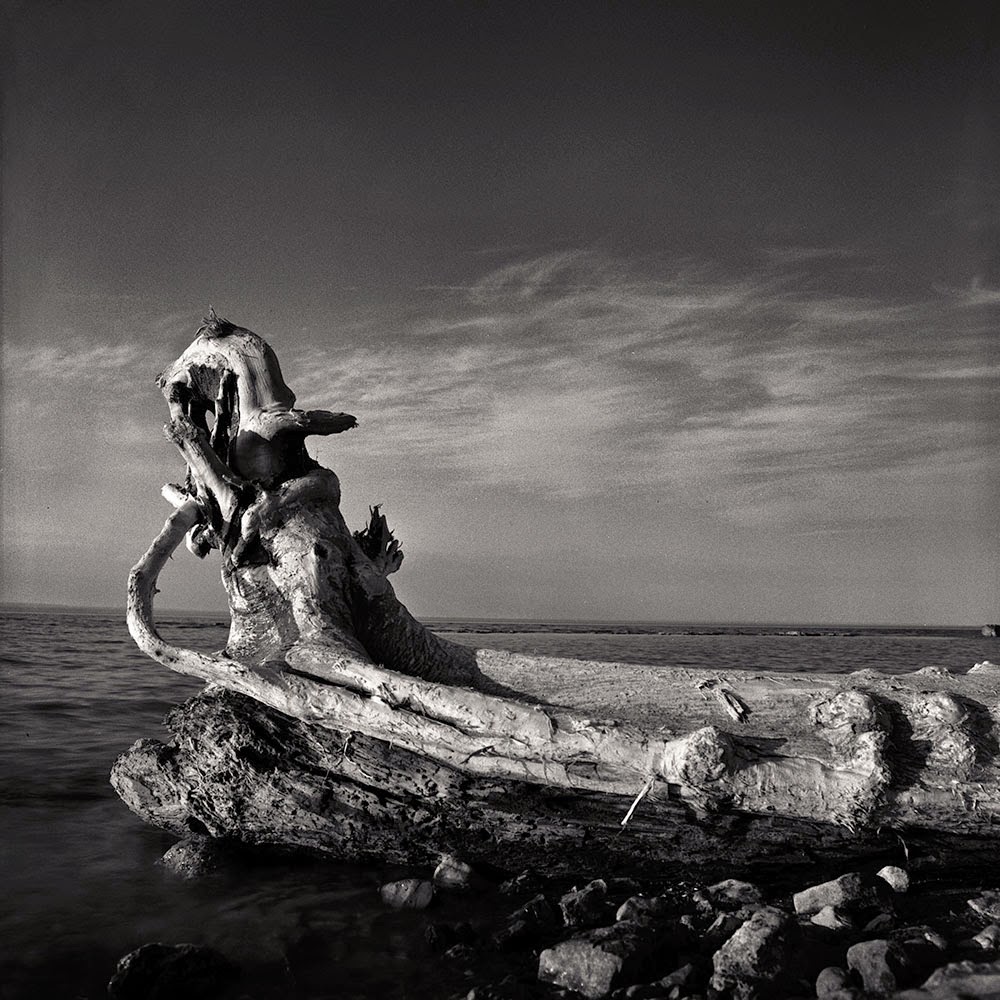
I call this image "Driftwood Dragon", not because it reminds me of the actual creature so much as the dragon figurehead on some ancient ship of war. It's the remains of a tree that, who knows, may have been uprooted and set adrift in Lake Superior, ultimately coming to rest along my favourite little stretch of beach, just shy of the Niagara. It's one of many driftwood logs I have encountered along the shore now that the ice that had carried them is finally gone, a few of which, like this one, I found interesting enough to spend a frame or two on. This one, however, got more than its fair share. It's not that I found it all that particularly worthy of photographic attention so much as the sense I wound up getting that my every attempt to photograph it was accompanied by a particular darkroom mini-disaster. It was almost like a curse.

This isn't just a tale of my efforts to take a picture of a log however, so let me back up a little to put the story in its wider context. While most of the home darkroom practicing world chooses to develop roll film in plastic daylight tanks, most notably those made by Paterson, my preference has always been for stainless steel tanks. The relative merits of each are a discussion for another day. Suffice it to say that that's what I was comfortable with. When I got my enlarger last summer however part of the lot that it came with included no less than three of the plastic Paterson tanks along with a host of reels. For the most part these had been sitting on a shelf ever since, though I did find uses for them now and then.

One such occasion came up a few weeks ago. I returned from an outing to put the Bronica I had just picked up through its initial paces with two rolls of HP5+ to develop. This has never been a standard film for me but I wanted bring something a bit faster into my arsenal to make it a bit easier to go tripod free when the situation calls for it. This also seemed like an opportune time to finally try Kodak Xtol, a developer I had been considering for some time and it seemed like a good match for the HP5+. I actually wound up getting eco-pro, an Xtol "clone" that is rumoured to come off the same production line.

I could have used the larger Paterson tank to develop both rolls at once, but as these were test rolls and I was using a new developer I wanted to at least have a peek at few frames on one roll to be sure everything was okay before going ahead with the second. I processed one of the rolls in the stainless tank as usual and a quick look coming out of the fix showed everything looked fine, but not wanting to wait for that roll to be hung to dry before starting on the second I decided to process the next one in the small plastic tank. Once everything was finished and I had a chance to look at the scans however I got a bit of a surprise. While the negatives from the stainless tank showed a pronounced decrease in density towards the centre of the image compared to the edges, those processed in the Paterson tank seemed perfectly even. The problem itself may be fodder for a future episode, but suffice it to say that since then I have switched to using plastic reels and tanks.

Now jump forward a few of weeks to find me spotting our lump of driftwood on the shore early one evening. There's some fairly interesting clouds in the background though the light is a bit flat. Finding I can't get low enough with the tripod I set the camera down on a convenient flat rock, propping it up with a few twigs to get the horizon level, and make a couple exposures, the second and third frames on a roll of Fuji Acros. Finishing the roll before heading home I developed it that evening only to find that both frames were riddled with pinholes, little spots on the negative where the film is clear. This is much more of a concern than dust spots since not only are they permanent, but they come out on prints as black spots that, unlike white dust spots, are nearly impossible to retouch.


Above is a scan showing the worst of the two negatives with the majority of the pinholes circled in red. There are actually more than I have indicated here that are either small enough not to noticed or are relatively hidden in the darker areas of the image. The scan would be a five minute retouch job in Photoshop, but I wouldn't waste the time paper and chemistry to print this in the darkroom. I've had the occasional pinhole in my images before, but nothing like this. I'd done something different this time though. After reading through some forum discussion on the practice of pre-soaking film before starting with the developer, my standard practice for years, I decided to skip this to see if it made a difference. Well, obviously it had I thought, lesson learned.

Two days later I was up at dawn with a few hours to kill before I had to head for work so I tossed the camera bag and tripod in the trunk and headed out for some morning photography, including a re-shoot of my dragon boat log. The light was much better now, so maybe it was a blessing I had problems with the first shots. Even the little twigs I had used to level the camera were still there as I had left them the other day. I set up just as I had the day before and did a couple of exposures, then just for insurance switched film magazines and playing around a bit with exposure and filtration did three exposures on HP5+ before finally switching back to the Acros to make two more exposures from a slightly different angle.

I finished the roll of HP5+ a couple days later on some shots of my daughter and processed it right away. This time there would be no skipping the pre-soak. The result was nine negatives completely free of pinholes or any other nasty defect, but though they weren't as bad three images were still marred by them. Guess which three.

I should take a moment here to discuss some of the causes of pinholes that appear like this on negatives. By far the most common is air bells, little bubbles that cling to the surface of the film, preventing chemistry from reaching the film. The best remedy for this is to rap the tank sharply a few times after the developer is poured in and preferably after each agitation cycle. I'm a bit of a fanatic about this, having once broken a tank in my efforts to ensure any air bells had been thoroughly shaken off, so I don't imagine this sudden issue is the result of any lack of bubble-jarring diligence on my part. A pre-soak also tends to diminish the tendency for air bells to form which may be why the problem was so much worse when I didn't do this. Pinholes can also form as the result of chemical action when the film is taken out of the alkali developer and suddenly introduced to an acid stop bath, but I don't use an acid stop bath for film, preferring a water rinse instead. Finally they can appear as a result of dust or debris lying on the film surface at the time of exposure. There may be other known causes, but I'm not aware of them.

Pinholes in a portion of one of the HP5+ negatives. You probably don't need me to circle them.

So now I needed to start questioning everything. There are some flaws that can be accommodated for or worked around but pinholes aren't one of them if you're hoping to make some top notch prints in the darkroom. The problem was there were so many things to question - a developer I had only just begun to use, processing tanks that were different from the kind I had used for years, even a camera I haven't had all that long. Time to start narrowing down the possibilities.

First up was the developer. When I finished up the roll of Acros with the remaining log photos, rather than using the eco-pro I mixed up a batch of Beutler's, a tried and true formula for me and a favourite for me with fine grained films like Acros. It also occurred to me that all of the problem images were among the first few images on the roll. These would have been on the innermost part of the processing reel, so as a precaution I wound the film onto the reel starting from the other end. The result? Pinholes in three of the four images of the dragon log. The image at the top of this post is the only one out of nine taken of this subject on which no pinholes were evident.

For my next roll it will be back to the stainless steel tank. I do get the impression that the more tightly wound plastic reels of the Paterson tanks tend to trap more tiny air bubbles than the stainless reels. Paterson tanks are by far the most popular type of developing tank out there however, it's hard to imagine they have an inherent flaw like this that nobody's talking about.

There is just one other possibility that comes to mind when I consider this - these problems have appeared on the last three rolls of film, each roll having twelve images for a total of thirty-six frames. Of those thirty six, nine were of this driftwood dragon, eight of which were marred by pinholes. I have had a decent look at the remaining twenty-seven and twenty-six of them don't seem to have any problem at all. Maybe I just need to stay away from this log.