Showing posts with label black and white. Show all posts

Wednesday, 16 May 2018

Deathbed Vigil for an Old Favourite


Unless you're brand new to film photography you/ve been witnes to the buzz in the photographic community that comes with the announcement that a new film stock is about to hit the market, or more likely an old one is being re-introduced. Just as surely you've seen the the reverse play out when a film stock disappears from the market. While inevitably these announcements are accompanied by lamentations by some about how this is a sign that choice in the film market is drying up, the wiser among us realize that in the wider picture there is no such trend. Of course things will never be the same as they were when film was the only viable way to do photography, but that's a done deal now. For the most part anyone who was going to give up using film for digital has already done so. What we see today is not a decline. Films come, films go. They always have.

Of course it's a little easier to keep this perspective when the film whose immenent demise has just been announced is not one of the mainstays of your own working method. Sure it was a shame when the Kodachrome process was shut down for good, but honestly I hadn't shot with that particular film in the ten years prior to that. In the past all of these discontinuations came and went with me sad to see another emulsion go, but happily going on with my work no differently than before.

This time though, with Fuji's announcement that they will be discontinuing their Neopan Acros in all formats as of October 2018, five short months from this writing, it finally hits home for me. It has been roughly five years since I returned to shooting film for virtually everything creative that I do. Over that time, though I haven't kept count, I'd say at least half of the rolls that have gone through my cameras have been Acros, and it wouldn't surprise me if I were to learn that it had been a good deal more.

If you're not familiar with it's characteristics, Acros has all the basics covered. It's a 100 ISO black and white negative film with sharpness and grain that put it in roughly the same league as Kodak's T-Max. While it's almost purely a subjective thing, its tonality is something I find pleasing, and at the very least few find it objectionable. Acros has a few other tricks up its sleve though. It is uniquely good at handling highlight detail. This makes it particularly useful in contrasty situations. This also means over exposure is less of a worry, so if you're struggling with shadows you want to see detail in you can usually give it an extra stop and let that lattitude cover the rest. If one were looking to fault Acros you could accuse it of being so forgiving as to invite carelessness.

To me though shooting Acros comes with one over riding delight that beats all the others, and that is that reciprocity failure is something you almost don't have to think about (For those not familiar with reciprocity failure please see the excellent explanation by Mat Marrash on the FPP web site.) Given that I, like many photographers who share a love of the landscape, enjoy experimenting with long exposure techniquest, this makes it a very special film. With many black and white emulsions exposures as short as one second may require an exposure adjustment to compensate for the film's deficiencies with lower light levels. With Acros no adjustment is needed for exposures of up to two minutes.

Now I'm not above bringing along a reciprocity cheat sheet or even doing a bit of math in my head, so why worry too much about having to compensate? It's simply that reciprocity failure can quickly get out of hand, and the more prone to reciprocity failure a film is, the more easily this can happen. With some films for example, if after accounting for reciprocity failure I determine and exposure of 30 seconds at f/8 is appropriate, but feel the scene requires me to stop down to f/16, my new exposure time may become not 2 minutes as we might expect, but 7 or 8 minutes. And if the light may be changing on you over that duration of time the shutter is open any real chance at an accurate exposure may come down to little more than a semi-educated guess. For my money, its' best just to keep things as linear and predictable as possible.

Of course the final factor is simply that Acros is what I'm used to, it's what I've learned to handle. For me it is a known and predicatable commodity. In my case it even has an added bonus in that processing time in my developer of choice, PMK Pyro is exactly the same for Acros as it is for HP5, which is the film I usually turn to when I need a bit more speed, so I can just develop everything together.

Change is inevitable of course, but that doesn't mean we can't fight it. Even though I probably had enough Acros on hand to get me through the summer as it was I immediately put in a panic order as soon as I heard the announcement. Shortly after this Acros was nowhere to be found at any of the online outlets I knew or could find. This was probably due to a rush created by all the other fools who made the same panic buy I did when they heard. When they went out of stock I saw that B&H simply listed Acros as discontinued making me wonder if that was it, so when it was again listed as in stock earlier today, you guessed it, I put in another panic buy. I imagine there will be one or two more in the coming months, as well as the need to buy a larger freezer. I may be in Acros for a few more years yet.

Of course that's only prolonging the inevitable, but so is all of life if you think about it. What happens when it's finally gone? Seems I should have a while to think about it. By then there may be something new.

Sunday, 26 February 2017

Counting Down to the Countdown


Perhaps not unlike many of you reading this I have been keeping half an eye on the Film Ferrania site for the past couple of years now. Tonight I checked in for the first time in a while expecting the usual reports of slow steady progress but happily I found more than I expected. Much more. Admittedly some of you may be way ahead of me here so apologies in advance if this is old news to you. Any new film is welcome news, especially when it is introduced by a new (or at in this case resurrected) manufacturer. Given that Ferrania set their sites on the E-6 market and I'm primarily a black and white guy however my interest has been more along the lines of wanting the best for the overall health of the analog photography industry. Sure I plan to get myself a few rolls once they hit the market and still kick myself for waffling over whether to contribute to the kickstarter until it was over, but if my overall pursuit of photography could be described as a journey, I can't see it being much more than a quick side trip.

Not that long ago Ferrania noted another mile stone on their site, having produced their first test film. Naturally enough it was a black and white emulsion. They even shot the film and posted results. Looking at them it's easy to see why this is an important step. For a first ever go it looks like they made a pretty decent film, but the results revealed production problems that need to be solved, streaks in the emulsion and blotches caused by bubbles in the emulsion. You can't solve a problem if you don't know about it. Baby steps right?

Well, that was a couple months ago and as news often trickles out of Ferrania rather slowly I didn't think to check the site again until tonight. Featured heavily are images of a box of Ferrania P30 Panchro film. This in itself seems no big deal. Prior to the demise from which they are currently being resurrected Ferrania was a company with a long and storied history and P30 is the most classic of their black and white emulsions. This doesn't look like any of the classic packaging I've ever seen though and as I read on I quickly learn that it's not. It seems that first go at producing a black and white film for testing was more than just a stepping stone on the way to producing a much more complicated E-6 emulsion, it's also become the basis for a new version of P30 that Ferrania is getting ready to introduce to market. I don't know about you but this is something I'll be keeping my eyes actively peeled for.

It's hard to know how long this is something Ferrania has had a notion to do. When the kickstarter was launched it was clear they had determined E-6 was the way to go. It only made sense.  E-6 was, after all, something that the old Ferrania had experience with. More importantly, at the time Fuji was the one and only company making colour transparency film, and their history of dispassionately discontinuing any emulsion the moment it appeared demand no longer warranted its production meant there was no guarantee even they would remain. But while Fuji remains the only manufacturer currently producing E-6 films, as noted last time Ferrania is no longer the only company gearing up to join them. With Kodak expecting their new Ektachrome E100 to hit the market some time next fall it seems the colour transparency market is no longer relying on Ferrania alone to shore it up against the possibility that Fuji's offerings will eventually dwindle down to nothing. I can't help but think that this had something to do with Ferrania's decision to turn what might have been just a stepping stone into a landing of its own.

Hoping to get your hands on some? As of this writing Ferrania's Shop page makes it clear an announcement is imminent. There's a line of large text reading "This text will become a countdown clock in just a few days! Watch this page!!". Presumably the coutndown will start soon. We're just counting down to that.

Saturday, 17 December 2016

Back Into the Vortex


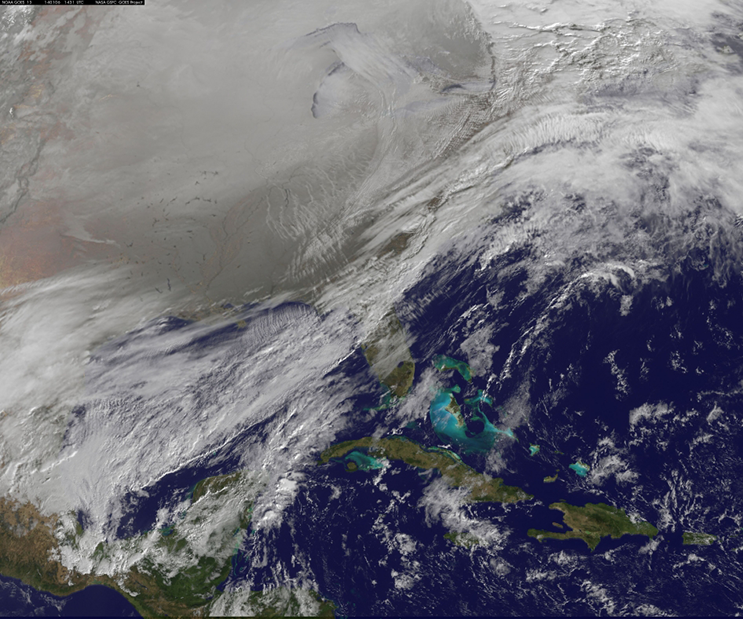
Two years ago I posted "Budget Time Travel : A Photographers Guide" explaining the notion that, at least in sorts of latitudes where I live, winter photography can transform familiar, well worn scenes into something other, providing the photographer willing to brave the cold with an alternative to long distance travel in order to find fresh subject matter. That was written during the winter or 2014-15, the second year in a row in which a weak polar vortex failed to keep arctic temperatures confined to the arctic, allowing them to run amok over the eastern half of North America including the Great Lakes region. Last year though the term 'polar vortex' which was becoming oh so familiar was replaced with 'El Niño', and with it came more mud than snow. While this was a relief in just about every other way, it didn't make for much photographically.

NOAA/NASA GOES Project Image
So here it is, mid-December 2016 and for the third time in four years we're hearing about the polar vortex again. Really I've been hearing the term bandied about since the summer, usually in discussions that started with the old "they say it's going to be a nasty winter" without any mention or probably even conception about exactly who or what "they" are. It wasn't really until just this week when a normal, possibly even warmer than normal autumn suddenly gave way to mid-winter conditions that I took much notice. Not that I or anyone else who lives in this part of the planet had much choice if they had any plans involving stepping outdoors.

As this cold weather snap coincides with that time of year where days are so short I drive both to and from work in the dark it wasn't until yesterday I had some free time during daylight to take advantage photographically. Given this is also the time of year for holiday preparations it was not a whole lot of time though, so with time constraints I decided to stay in town and make the most of my favourite local well trodden subjects, a decision it seems that turns out to have been the right one.

Take the lead image for example. Some readers may recognize the subject as that same crumbling break wall that was featured in my post almost exactly a year ago in "One Subject, Many Approaches II". It also appears in the post just previous to this. Other than being some structure jutting out into the water, with its thick coating of ice it seems almost unrecognizable here. I had actually headed out the door on bright sunny morning to do some shopping but noticing the heavy band of clouds hanging over the lake turned around and collected my Mamiya gear. It was only in the last few hundred metres of my drive out to the lake that the sun became obscured by cloud cover. That came as a bit of a disappointment as I'd been hoping to capture a dramatically sunlight foreground to make the dark clouds over the lake seem even more dark and ominous but looking at it now that might have been too much contrast. The clouds are plenty dark on their own. It only got cloudier the longer I stayed and before long I was having to take measures to keep the falling snow from collecting on my equipment.

I made the mistake of leaving without a good cable release. I had the $5 cheapie that sits at the bottom of the pack as a spare but after an hour or so in the cold that came apart and with the diminishing light as the once distant clouds moved overhead started bringing exposure times uncomfortably low to manually release even with the tripod I decided that shopping I had shouldn't be put off too long. I did manage to slip out again later that afternoon just to finish the last half of the roll that was in the camera.

I guess it's possible that this cold snap may be just the prelude to an otherwise normal winter. If so I was glad I got this chance and there will no doubt be a few more notable days before the season gives way to spring. On the other hand given how things so far are right in line with what the meteorological pundits have been saying, and experience with other recent winters, this may be just the tip of the iceberg.

Finally, for your enjoyment, here's some more from my first photographic foray of the new winter:


Tuesday, 3 May 2016

Pinhole Day 2016

It's a darn good thing somebody goes to the trouble of organizing the annual Worldwide Pinhole Photography Day. I wrote about the tribulations I experienced during the 2015 WPPD while I was still shaking out some of the bugs involved in using the 8x10 pinhole camera I had built the previous autumn, the details of which you can also find back in the September 2014 archives of this blog. Consisting of a box with a teeny hole at one end, the camera itself wasn't the real issue so much as the here were no real issues with the camera itself on that day so much as dealing with the resulting exposures, namely the contrasty, highly scratch-prone x-ray sheet film employed. I was trying something new so it was the usual case of learning a few lessons and making a few adjustments. The trouble is that with everything else going on in my photographic life I didn't get around to trying out those new adjustments until WPPD 2016 came along and lit a fire under it.

My choice for entry in the WPPD 2016 on line gallery - image #1234 as it happens.

Worldwide Pinhole Photography Day itself is an event simply to celebrate photography in arguably its simplest form and to raise awareness of the power and expressive potential of photography done with traditional materials and tools. It's also a great educational opportunity. Grade school children can build pinhole cameras from materials as simple as a shoe box, baking foil and a bit of tape, load it up with a sheet of photographic paper then after making an exposure develop the image using a simple darkroom setup, all in the course of an afternoon. It's science and art all rolled into one. For me though it's simply a reminder that pinhole photography is something I have in my photographic repertoire, or it's supposed to be anyway. I shouldn't need the reminder, but there it is.

While WPPD falls on the last Sunday of every April my day job allows little consideration for weekends, so as had been the case with the previous two WPPD's I participated in I did not have the full day to work with. Just as well perhaps as with two 8x10 film holders to my name I was limited to making four exposures. I had a few locations in mind that weren't too far from where I work so it was a cinch to get it all done on the way home.


Making the exposures was the easy part though. I still had to deal with getting those large finicky x-ray negatives developed. I wrote about my results from last year in Pinhole Day Misadventures so I won't reiterate the issues I ran into here.  This year however I had the hangers and tanks at my disposal so I wasn't expecting negative scratches to be an issue and as it turns it wasn't. My second concern was the excessive contrast I have been getting from x-ray film with standard film developers. Though it can be developed by inspection under red darkroom lighting, the Xtol I used last year resulted in empty shadows despite developing until the highlights were as dense as I dared. My current standard, PMK Pyro, is a compensating developer and would probably give much better results. The 8x10 tanks however require a full 5 litres of solution, and while I probably had enough on hand to mix that much it would have left me short in short supply for other purposes. Having raw ingredients on hand I did a bit of research and decided on a particular Caffenol formula called Delta Micro. Formulated for low speed, high resolution micro films which have similar contrast requirements it seemed right for the job, and what do you know, it actually worked as well as I'd hoped.

Developing by inspection again I found that, unlike the Xtol which brought up a clearly visible image in about 15 seconds, it was several minutes in the Delta Micro before I could see anything happening at all on the film resulting in just a little bit of panic, holding the dripping film hanger up to the safelight to satisfy myself I saw some sort of image forming. Though I didn't time anything it seemed about 10 minutes until they appeared ready to move on to the stop bath. The negatives looked good, displaying a nice range of tones similar to those I expect from standard negatives. The only trouble I , could see were some areas, mostly towards the middle of the image, where they seemed to suffer from a sort of hazy fog. Maybe this was the result of having x-ray film, with its notoriously short shelf life, sitting in film holders for the better part of a year, or maybe it was all that close examination holding the developing negatives up to the safelight. Future experimenting will be needed to sort that one out.


It wasn't horrible but the negatives were denser and lower in contrast in these areas, creating a challenge in the darkroom, especially since I was contact printing which made it a little harder to judge exactly where to burn. For the most part they contact printed well on Ilford MG-IV RC with a #3 contrast filter which was replaced with a #5 filter when burning in those denser areas. The results were okay-ish, but I gave in and did a bit of extra work on the image of the railway tracks in Photoshop after scanning in the contact prints to help even things out a little more. There is still a little of the effect visible in the image below of the graffitied overpass pillars as it occurred to me the fogged area just happened to fall on exactly the right area of the image to resemble a slight mist, though no such mist was actually present.


Each participant can submit only one image each year to the WPPD online gallery. It's not a competition, there are no prizes, images are not judged or ranked in any way and there are not sort of minimum standards to be met other than that images must have been taken on the day of the event with a lensless camera of some sort. I would have been happy with either of the images here, but the perspective and foreground details made the railway bridge shot an easy choice. I filled out the online submission form and uploaded the image. In 2014, the first year I entered, my image came up as #888, and I was pleased it was something so easy to remember. This year I have image #1234. If I'm going to be lucky like that, why can't it be the lottery. (Answer: Because I don't play.)

There may be a few kinks left to iron out but with these results I can see the potential for achieving a unique look that is desireable and can't be matched using standard lenses. Yes I have plenty of other pots on the go, so to speak which I'll no doubt be writing about with equal enthusiasm in the weeks and months to come. Still, there's no shortage of things I hope to do and explore with pinholes, and there's still plenty of x-ray film in the freezer. Hopefully it won't take WPPD 2017 to get me out with it again.


Saturday, 9 April 2016

The Lake Is A Lie


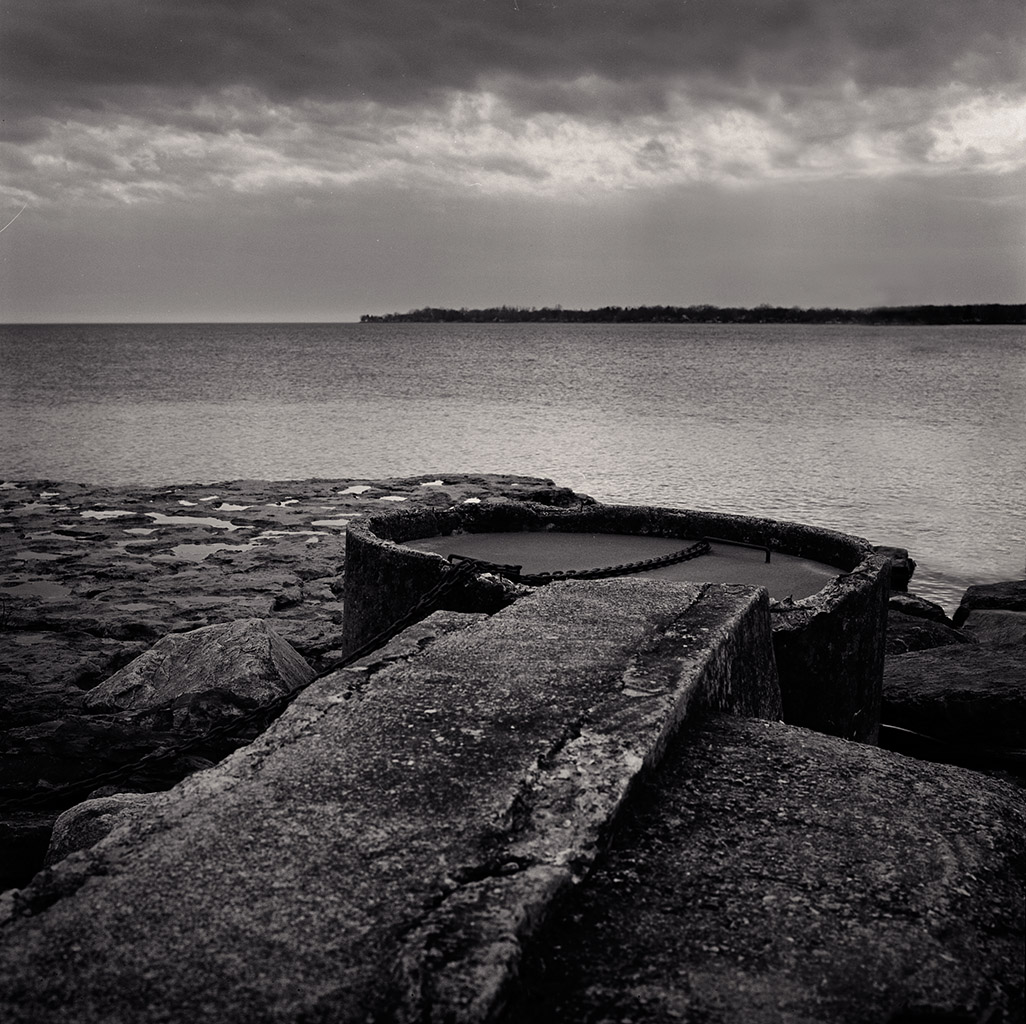
Here's a lovely little image taken from a rocky beach along the shore of Lake Erie that I had such high hopes for. It had been a bland day up to shortly before this image was taken, the textureless overcast of morning having gradually given way to a cloudless blue above without even that brief transitional play of cloud and light to provide visual interest to anything above the horizon line. It was only by virtue of a long standing inability to learn when to give up that I was still out there at all when a lucky cloud bank rolled in, providing about a half hour or so the conditions I'd been wanting for all day. In that time I fired off the remaining half of the roll I had been working with all day to that point and made a fair start on another. The entire day of wandering aimlessly with a camera had been worth it after all.

Or so I had every reason to believe up until the moment, later that evening, when I pulled the roll off the developing reel in order to hang it to dry. It was only then that I learned the sad truth, a truth that means, lovely as this image may seem at first glance, it will never see the light of... well, an enlarger lamp. Things are not as they appear here.

You see friends, the lake is a lie. What you see is the result of a not particularly meticulous Photoshop rescue of a painfully ruined image, unrescuable by standard analog means. Worse, it is the result of problem that affected exactly those images that were taken during that half hour I thought had been the day's salvation.

Here is the photograph I actually took...


The culprit... a piece of plastic film that formed part of the light trap for the dark slide slot of the film magazine. I would assume that on inserting the dark slide I had pushed it loose so that it jutted into the image area, where it appeared on all subsequent exposures until I discovered the problem. Not wanting this to be a total loss I spent about a half hour fooling around with the rubber stamp tool, magic healing brush and the like until I convinced myself I had something passable enough for the casual once over the image would get when posted online. Knowing the truth of the matter though I don't imagine you'll have much trouble spotting the flaws. I haven't had the heart to tackle several other hoped for masterpieces that were similarly ruined.

Once the problem was known I was able to take the film magazine into the darkroom and by feel find and extract the offending piece of plastic without even having to sacrifice the remaining exposures on the film which all came out fine (though honestly I just blew off the rest of the remaining frames on some so so images for fear that, if there were light leaks, I'd care about the images that were wrecked). Despite the damage the light trap has never the less performed adequately since with no hint of darkening along the edge of the two rolls that have gone through since. I was fortunate that a quick search turned up a fellow who sells complete light trap kits online, not just the foam but the little Mylar bit that came loose in my case. It arrived the other day but will have to wait until the next roll is through to be installed. If I hadn't found that neat solution I also found a DIY alternative suggested in a few online forums involving cutting a substitute plastic film literally out of film using the exposed and developed leader end from a 35mm roll, the part that usually gets cut off and tossed once the film is dry. It's a good idea to file away for the future - there's no guarantee ordering one will be so simple next time I need to redo the light trap. 

Arguably if I spent more time on this I could get a nearly flawless image, indistinguishable for all intents and purposes from what I would have come away with if that little piece of plastic hadn't come loose in the first place. I've spent far less time on this, after all, than I would normally invest making a decent darkroom print from a good negative. In theory a digital negative could then be made and contact printed in the darkroom yielding a traditional silver print. Don't look for it to happen though. It's not that I'm some some sort of purist, I have no principled objections. I just don't see myself ever having the motivation. There's plenty of other good images I could be printing. Why fake the lake?

The good news? That concrete drain looks like it's been there for a while. It will probably be there just the same when I go back, film magazine intact this time.

Thursday, 31 March 2016

A winter of... meh

Taken with the Bronica S2a with a 75mm Nikkor-P lens with an orange contrast filter on Ilford HP5 Plus.
Last year I wrote at length of my photographic revelry during the winter of 2015, a year in which Lake Erie came very near to freezing over completely. I noted how winter, at least at my latitude, can transform a landscape that was feeling a bit photographed out into something altogether fresh, and how I was therefore looking forward to what the winter of 2016 would bring. Well, it looks like for the most part El Niño put the kibosh on that idea as Winter really only put in a few token appearances this year. 

I was perhaps being a bit too optimistic in my hopes that this year would be anything like last. El Niño aside the consistently frigid temperatures of the previous year certainly seem to have become more the exception than the rule these days. But although the ground remained conspicuously un-snow-covered much of the time, there were still those token appearances, temperature drops lasting the better part of a week that, while they were too brief to produce the grand ice desert landscapes of the previous year, did bring about a few situations that wouldn't occur at any other time of year.

Case in point is the image up top. The glazed structure in question is part of concrete remains of the long abandoned Erie Beach Amusement Park that is my default destination when I'm not up for a drive out of town and don't have any better ideas. The doorway here leads into a sort of concrete room of sorts that served who knows what purpose back in its day, which is at one corner of a sort of sea wall that encloses about a hectare now overgrown with trees and cat-tails for, again, who knows what purpose. On brighter days it's possible to see to the bottom of this "room" to a floor of rocks and broken concrete, along with the occasional beverage containers and other artifacts suggesting periodic exploration by those presumably much younger than I. Photographically it's always been a bit of a challenge to me in that it seems like something that should be more interesting than any of the images of it I've come away with.

On this day however the combination of strong winds and a particularly brutal (at least in context of this winter in general) snap of cold had transformed its gratified concrete walls into something other-worldly.  In a colder year in fact it's something that wouldn't have happened at all as it wouldn't have been possible for the wind to spray the surface with water, which then froze, had the surface of the lake been frozen over. Those wild conditions had happened the night before. Things were nice and calm the next day when I got there, a few somewhat eerie clouds having moved in to compliment the mood. As you can no doubt guess rendering them as such required no small amount of burning in, accomplished here via Photoshop as the darkroom has become temporary storage through the winter while work has been going on elsewhere in the house. I'm guessing this is something a lot of home darkroom practitioners out there would relate to.


If the story of cold combined with strong winds on Lake Erie coating things with ice this passed winter sounds familiar it may be due to an image that widely circulating around the internet last January depicting a car frozen in place and completely covered over in a layer of ice. This happened in Buffalo NY, just across the way from me and, surprise, was the result of the same set of circumstances that gave that car its frosty coating. I somehow doubt that my image will make its way around the internet to the same extent. It's a shame too because, while I'm admittedly biased, I think mine is the better photograph.

Monday, 14 December 2015

One Subject, Many Approaches II

The Wall and The Bright Side of the Moon

This past summer I wrote a post called "One Subject, Many Approaches" where I looked back on the results over the years of my efforts to photograph the same subject I'd photographed many times in the past, all the while trying to keep the images fresh enough to avoid the creative dead end of making essentially the same photograph again and again. In this sequel episode I'll be presenting another one of those well worn subjects I keep returning to. It is the crumbling remnants of a concrete break wall that once helped still the waters for revellers at the long defunct Erie Beach Amusement Park. Now if that sounds a bit familiar it's likely because the original One Subject, Many Approaches centred on another ruin, the concrete base of a carnival swing ride, from that very same attraction of yore. It is just a quick jaunt, about 300 metres, from this disintegrating nautical structure that is the focus of today's episode, and it wouldn't be at all unusual for me to come away from a little afternoon stroll with images of both. 

Proximity aside however the number of appearances these two subjects have made in my photographic corpus can be attributed to two simple virtues both posses - I find them interesting, and they are convenient. If I only have an hour to kill, if I'm testing new equipment, if there's interesting weather or lighting conditions that could disappear anytime and I need to find a subject now, I know I can get something if I take the five minute drive to old Erie Beach. Still, it's hard to shake the notion that it's really too easy, an almost guilty sense that another trip out to the wall somehow falls short of doing something photographically worthwhile. In spite of this, I often come away with results that surprise me a little. Maybe it's just the low expectations I have for the results.

Here is one from my early days with the RB67, a time when I was still a bit giddy to finally own such a camera. I was smitten with the works of a host of photographers known for their work with long exposures. Lacking a proper neutral density filter at the time I would set up in the fading light of dawn when, if I timed it right, I might be able to make two or three exposures with shutter speeds of one then two then several minutes before they finally became unworkably long.

My first experimental roll putting 35mm film through the RB67, yielding panoramic sprocket hole images. Obviously I wasn't so careful levelling the camera but tilt the film a bit and it almost looks like I meant to do it that way.

An example of the classic leading off to the horizon composition I see as a metaphor for our ceaseless journey into an unknown future that beacons us to a destiny at once fearful and full of promise. Others have suggested images like this are straight up phallic. Hmpf... Freud.

Here's one from this past October that I could have included a few episodes back in The Cool Colours of Autumn. Not a great success but I was just a tad too late to catch just a brief few seconds when the setting sun burst through the clouds casting the wall in a bright warm glow. Even though I had the F80 set to auto focus aperture priority, by the time I realized what was going on and managed to compose this shot it had all but faded. 


There were days this year when water levels in the lake have been unusually high, the changing water levels at times seeming quasi-tidal.  Here a driftwood log serves as foreground interest as the wall, nearly level with the waves, is barely noticeable. There was a workman from the town at the beach that day who, seeing me pull out the camera informed me that I was too late, that there had been a rainbow out over the water that had faded away only minutes before. Looking at that cloud I can't I've lost that much sleep over not having arrived earlier.

Finally here's one from my most recent roll out of the Bronica S2A. Obviously water levels were much lower this time and I decided to chance a stroll along the wall itself. I had been out exploring new locations but with a bit of time yet to kill made a quick side trip on the way home to blow off the last few frames on the roll. Figuring I would travel light that day I left the tripod at home, an unusual choice for me. Regrettable as I could have used it here. With the short days the late afternoon sun was already beginning to fade on an already bleak day and shooting hand held forced a shutter speed/aperture trade off I just couldn't get the better of and I wound up sacrificing foreground sharpness I would have sooner kept. Negotiating the crumbling sections of the wall is a bit tricky to begin with and doing so with a bag containing prized cameras and lenses always feels like a calculated risk, It looks like I may have to do it again though.

Sunday, 22 November 2015

Abstract


When I was posting the above image on my Flickr page the other day I stopped myself short of tagging it with the term "abstract". In practical terms it was a good tag to use, a word a lot of people might search on, drawing more eyeballs to my image. It made me uncomfortable though, so that even after I finally decided to use it I went back and took it out. Heaven forbid I do anything myself that might lend credence to a photograph, one I took no less, being referred to as "an abstract."

 Before you jump to any conclusions though let me hasten to add that that "abstract" is not something I find objectionable or in any way wish not to be associated with my work. Quite the opposite. What bothers me is that when a particular image is deemed to be "abstract", especially "an abstract", the implication is that it possesses some quality that distinguishes it from all those other images that aren't abstract. The problem is there are no such photographs. If I could point to a single realization I've acquired over the years that is most critical to who I am as a photographer today it is the understanding that when I make a photograph, especially one with any sort of expressive intent, abstraction is, without exception, the whole point. That point only gets lost when the term is used to single out only some images from all the rest.

To be clear here I'm not imagining that acquired any special talent that allows me imbue my work with some subtle abstract quality that I'm surprised others don't see. What I'm suggesting applies equally to anyone who has ever made a photograph whether or not they had any notion of this. While this may not be of much interest to those who do photography practical documentary purposed, but even here images are occasionally seem to posses a compelling visual appeal purely by accident. The reason is simple, a camera is a tool of abstraction, that's what it is, that's it's very nature. In short, if it's a photograph, it's abstract.

By this point I am imagining most if not all of you are thinking something along the lines of "But that's ludicrous. I know what abstract art is and that beautiful shot I took of my nephew standing by the window that everybody loves so much is not it!" So if you are thinking something along those lines, given that we're all intelligent, reasonable people here, it's probably safe to assume that I'm not using that word abstract in quite the same way you are. If this were a mere semantic quibble though I'd have done you a disservice allowing you to read as far as you have. The understanding I've come to of that word abstraction though is how I make sense of the fact that the some of the most mundane sights, things you might have passed right by and never even thought to cast a glance towards, perhaps a row of dishes drying on a rack or a clump of trees lying across a soggy field of barley, can become the subjects of photographs we find absolutely captivating. Not incidentally I also find it immensely helpful in the way I understand and approach my own work. When you're trying to make a interesting photographs it can't hurt to have an idea about what it is about photographs that can make them so interesting. If you have a notion to read on then I'll try to make it worth your while.

First, let's talk about the way the word abstract is usually used with reference to art. I think it would be fair to say that whatever the particular usage it is meant to convey a sense of the intangible. We might call the work of a surrealist like Dali abstract because what it depicts defies our sense of how we've come to understand how the world works. Or it could be used with reference to "installation art" such as that pioneered by Marcel Duchamp who used very concrete objects to represent and invite the contemplation of abstract concepts. Perhaps more than anything however it calls to mind non-representational art epitomized by the work of Jackson Pollock whose expressive paint dripped canvases bear no relation or resemblance to anything found outside the world of the psyche. All are abstract, certainly, in obvious though different ways.

The only trouble with this in my view is that when a painting, photograph or any other piece of art is only referred to as abstract when it incorporates some unusual element of abstraction that makes it stand out the message is that when art doesn't have these elements the word abstract doesn't apply. The reason that's not trivial is that it can keep us from appreciating how the element of abstraction is at play throughout all art. As I see it, it is the very essence of art. So how can we ever understand art if we think the word only applies when, for example, a painter is attempting to depict a state of mind without reference to some external "thing"?

Having said that let me take a moment to reel things in a bit. I'm a photographer, this is a photography blog so let's get back to talking about photography more specifically. To me the central mystery of photography and why I even bother with it boils down to the following question:
 How is it that, finding myself before some rather pedestrian scene or object, something I might otherwise have walked right by without a thought, point a camera at it, trip the shutter and end up with something beautiful and engaging enough to want to hang on my wall so I can look at it everyday for years? 
Objectively that thing on the wall is just a pale reflection of whatever it was that I photographed in the first place. To start out with it's been removed from the context of its surroundings to be confined within the rectangular borders of a print. There's no motion, no depth, no hint of the sounds or smells that were present when it was taken. If it's a photograph I made chances are very strong even the colour has been left behind. Given that the thing photographed was often not worth a second glance to begin with this whole endeavour sounds like a profound waste, a good quantity of time material of effort gone to take something that may not have been all that interesting to start and make it even less so.

Except that it isn't. A photograph can be so much more than a poor substitute for the thing photographed, a mere memento. It can become a new thing entirely, not despite the loss of context, dimension or motion but because of them. When we remove these things we make them less specific and therefore more universal. This is how that old pair of shoes in the front foyer you just haven't gotten around to throwing out yet can, when photographed, become all things that have been cast aside and forgotten about. We may not even be aware of the symbolism when we see it, but w well conceived and executed photograph can make you feel it even though those actual shoes in the foyer strike you as a pair of meaningless inanimate objects that would be cause for embarrassment if they were still laying there when company stopped by.

What has happened here is abstraction. That may not seem like it has much to do with the way we usually hear the word abstract use. Commonly understood abstract is sort of the opposite number to that which is real and concrete such that abolishing slavery is a concrete action while freedom is the abstract notion behind it. Fair enough, but it doesn't really help much with our understanding of how a photograph of a thing can possess engaging qualities that even the thing itself lacked. For that I want to go a bit deeper at what that word I keep batting around, "abstract", means more generally. It's comes from the Latin "abstractus" meaning drawn or pulled away. It would have been used mainly to describe some sort of material process such as separating, or drawing away, the wheat from the chaff, the metal from the ore and so on. More simply it means to take a pile of stuff that is a mix of things you want and things you don't, pull away only bits you're after, and leave the rest behind.

Now as a photographer, if you hold it in mind that this is what abstract means you'll see at first that it's a process that's at play in every photograph you've ever made or ever will make. On a foundation like this it now becomes simple to understand how all of the camera's inherent limitations - the way it flattens a three dimensional scene, severing its connection to limitless surroundings to imprison it within a tiny rectangle, all motion arrested, all sounds silenced - these are not limitations at all but the source of its power, the means by which we draw the photographic wheat from the chaotic chaff of the world around us.

I believe any photographer possessing even a modest talent will have some intuitive sense of all this, and even if they go on to great mastery may never put their now highly developed sense into these terms. When we reserve the word abstract denote only work of a more experimental nature the developing photographer (i.e. any photographer not on their death bed) is left to grope in the dark on their own for this understanding. Nor is it enough to save the word to mean "especially abstract" or "abstract in an unusual way". For example, photography has been called an "art of subtraction", where subtraction means something very close to what I mean by abstraction, so why don't I just say subtraction and leave those who want to talk about abstract photography as a special category alone? The answer is that used this way the new word "subtract" in no way fails to apply once we start talking about the things people like to refer to as distinctly "abstract", such as an image in which we have subtracted the cues that normally allow us to clearly identify the subject, thereby introducing one more abstraction.

The problem isn't the choice of terms, it's that we're trying to use terms to draw a distinction between things for which no fundamental distinction exists. Pretending they do only obscures things more, stifling our understanding along the way. The kinds of abstraction we use - the more abstract black and white rather than colour or more abstract still photography rather than motion pictures - are creative choices and asserting that the choice to photograph the more abstract distorted reflection of a subject (thereby creating "an abstract") rather than shooting it straight on is somehow different in kind from all the other choices does nothing but put up additional barriers to understanding.

And if the word abstract makes you a little uneasy because you fancy yourself someone who goes for literal interpretations in photography, remind yourself that, in photography especially, the idea of being fully literal and the idea of interpretation are inevitably at loggerheads. As is true with so many things, in photography abstraction is inevitable. Learn to embrace it, to use it. It will bring you greater understanding and make you a better photographer. And if you're not sure how, imagine yourself standing in front of a print by a one of the great photographers who's name you would never think to associate with the idea of "abstract photography". Let's say it was Ansel Adams, and he was standing there with you so you could ask him how it was made. I don't know what his real answer would have been, but a perfectly true and valid answer could be... "I simply cropped away, desaturated and tonally compressed everything that wasn't Moonrise Hernandez."

See... abstract.


Saturday, 17 October 2015

Through a Filter Darkly


Long exposure photography, where the shutter is left open long enough to blur even slower moving subjects in the frame, has been with us for a long time. In fact in photography's early days the poor sensitivity of photographic plates compared to the film speeds we are used to today made it impossible to do anything but, requiring portrait photographers to put to use braces to hold their sitters heads still less any small motion during the many seconds to minutes the shutter was open blur the image. As film sensitivity improved and it became the norm for photographers to truly be able to freeze an instant in time and long exposure photography became something of a special technique. Often this involved night time exposures such as the familiar images of star trails, where darkness allows the shutter to be left open for hours even with today's more sensitive materials. Sometimes though it would be desirable to leave the shutter open for long periods of time even in full daylight, for example to give a soft gossamer appearance to the flow of water in a fast moving stream. When simply closing the aperture down to its smallest setting isn't enough photographers wanting to achieve this effect have long carried neutral density (ND) filters to cut down the amount of light reaching the lens by perhaps three to four stops which might allow exposures to be stretched out to a full second or more.

It's hard to say when but over the past decade or so a growing number of photographers began to push the envelope of where these long exposure techniques could be applied. By extending exposure times even further, to minutes instead of seconds, motion such as the rolling of waves or the drift of clouds across the sky could transform the entire feel of a scene, achieving a new level of abstraction by viewing the world over a time scale much different from those at which our eyes operate. Suddenly, rather than three or four stops, photographers began seeking out ND filters that reduced light by ten stops. There are now many such filters on the market.

If you have never used a ten stop ND filter, you need to look carefully at a rather bright scene to be able to tell that they are not completely opaque. (It is not safe to look directly at the sun through a 10 stop ND filter however, or any filter not specifically designated as safe for this purpose. This includes looking through the optical viewfinder of a camera with a filter in place. Seriously.) The effect, as you would imagine, can be dramatic, altering the feel of a seaside image as radically as the use of infrared film can transform a photograph of a forest scene.

Having moved beyond a technique a photographer could pull out of their bag of tricks for special occasions, long exposure is now often referred to as a different kind of photography, its own genre. Photographers have built successful careers largely, sometimes almost entirely, through their long exposure work. I wouldn't dare be so presumptuous as to try to list the "most notable" long exposure photographers, but to give you a taste you might want to have a look at the work of Michael Levin,
Keith AggettNathan Wirth or Paul Simon Wheeler.

Do so and you'll probably note the way bodies of water feature strongly in the portfolios of these photographers. While long exposure techniques affect the appearance of anything in the frame that is moving - windblown grass, clouds, humans - somehow it is water and the motion of waves that seem to create the greatest emotional impact, especially when the ethereal mist created by motion and time is contrasted with the solid unmoving presence of a rock, a pier or the wreck of an old ship. I imagine it would be hard to incorporate long exposure photography into your work if you lived out on a prairie.

Situated as I am among the Great Lakes, effectively oceans in terms of their photographic potential, I have favourable geography for long exposure photography easily at hand. It may seem a bit surprising, therefore, that it doesn't constitute a larger portion of my work. I should say first of all that this is in now way because long exposure isn't in line with any personal philosophy or ideal about photography. In my understanding the reason we might find photographs in particular so fascinating in a way that the actual scene photographed may not have hinted at even if we were present when it was taken is that the camera presents us with an image that is familiar and recognizable in a way we can easily relate to, but through an eye that sees the world in a different way than we experience it. We can make creative choices to record in a way that may be a little more or a little less like the way we see the world with our own eyes - motion versus still, colour versus black and white and so on. Often times we find the fascination deepens the more an image differs from the way our eyes see it. Add to this the photographic essence that anchors the image to reality and the fascination deepens. Long exposure photography then is just one more way in which the camera can see the world differently.

I hasten to add it is not an unreal way. If creatures somehow evolved to see the world changing on a time scale of minutes rather than fractions of a second what we see in a long exposure image might be a better representation of how the world really looks to them. To such beings the sort of everyday image we see now made at a shutter speed of 1/60th of a second might be as strikingly unusual as Harold Edgerton's images of a bullet frozen in motion as it emerged from an apple it had been shot through. While we tend to think of the way that we see the world as "objective" and any other way as somehow "unreal", these are accidents of the kind of beings we are. This isn't to say that how we see the world is irrelevant to the way relate to a photograph. I don't imagine an image of a scene made in radio frequencies would have much emotional impact. There needs to be that anchor.

In the end then my choice to stick with the usual sub one second shutter speeds comes down to the particulars of what my muse chooses to whisper in my ear at any given time. I choose to make long exposures sometimes, but not usually in much the same way I shoot colour film sometimes, but not usually. I just have to trust the muse, she's been good to me so far. (What, I can have a female muse if I want to.)

One reason I often don't choose to go with extended exposure time is clouds. If you've been following this blog for any length of time you'll know I love clouds. In fact the very reason I'm writing at this moment rather than being out there with a camera is that there's a beautiful cloudless blue sky outside my window right now - useless. The way clouds render in long exposure images, silken puffs rushing by like freight trains or sometimes extended into aurora like fingers reaching across the skies, can sometimes bring an ethereal sense of its own to an image, but that's not what draws me to the, at least not usually. I'm drawn to clouds for their form, foreboding, the play of light and the sense they give that the sky is a thing. Whatever an extended exposure times may bring to the way it renders clouds, much of the time these other things can be lost.

And so it was that last week I finally found myself at a beach on the shore of Lake Ontario I've been meaning to explore. The weather was terrible, and by terrible I mean just about perfect - blustering winds stirring up waves, dark threatening clouds with the occasional break to let the sun flood through. I walked the length of the beach with the big pack containing my Wista kit then, having shot all 12 sheets I had with me returned to the car and grabbed the smaller pack and did the whole thing again with the Bronica. I honestly hadn't given any thought to doing long exposure on this outing and while I had my 77mm thread size ND filter with me, there were no thread adapters packed anywhere meaning the one and only lens I could use it with was the 50mm Nikkor wide angle for the Bronica. It wasn't until well into the morning, when I came upon a large branch that had washed in from who knows where with what appeared to be a sort of cobbled together ladder I would guess once lead to a tree house still attached that I had any notion of getting it out. Objectively it seemed the clouds were just the sort I usually like to shoot just as they are (or as they appear to me) and the rough surface of the lake with waves that would curl then spread into a frothy blanket as the hit shore were ideal things to incorporate into the photographs I was taking but, you know, the muse.

I have two film backs for the Bronica and on this day one was loaded with HP5+ which is excellent generally and has the speed to allow me to hand hold when the need strikes, the other containing Fuji Acros which, among its other virtues probably the best film ever created when working with exposure times longer than a few seconds. As luck would have it the composition called for the 50mm, the only lens my 10 stop ND filter would fit. To this I added a Cokin graduated grey filter to save me having to burn in the sky later on and a pair of 90 second exposures were made. It seemed prudent to at least rattle off a normal exposure too so after switching backs, removing the ND filter and putting the grad filter back in place I did another shot on HP5+ at, I think, 1/30th.

The long exposure result is up at the top where it stands the best chance of catching the eye of potential readers. It is almost an entirely straight can of the negative though I burned in the lower right corner in Photoshop just a smidge. Now for comparison here is what I got without the ND filter:


For easier comparison here they are side by side. You might want to click to enlarge:


Your evaluation may differ, but even though I'd be happy with the normal exposure if that's all I had taken and your view of the situation may differ, I'll make no bones about the fact that I prefer the long exposure version in this instance. It's true too that I put a good deal more time in Photoshop with the standard version to get it to look as good as I think it could though honestly this is probably due at least in part to some vignetting imparted by the cheap no-name neutral density filter I've been using (even some expensive ND filters are prone to uneven expousre) doing some of the burning-in work for me.

Who is to day if I'll be making this sort of image more in the future. Maybe I'd use it more often if I had something better than a no-name filter. It's an investment I've been considering. (There's never a shortage of things one should consider investing in, is there?) At the very least I'll have to be more careful in future to keep my thread adapters at hand.


Saturday, 8 August 2015

One Subject, Many Approaches


A recent image of this old concrete relic I have photographed so many times before. Though it's really what's left of a
century old amusement park ride, here it seems to take on the feel of a forgotten ancient temple.

You may recall that last week one of the images featured, the crumbling "legs" of a concrete structure along the Lake Erie shore, was yet one more image of a subject I have photographed many times before. It's in fact just one of several features of potential photographic interest along that local stretch of lake shore I've mentioned here so many times before. Useful as it is as a place I know there will be a few images to be made if I'm testing a new lens or camera, or when I just don't have the time to go looking for images further afield, the decision to head down there has long been accompanied by the sense of going for the same old same old, the photographic equivalent of having no better idea than to order takeout pizza again. Yet as often as I have revisited the place and as much as it seems I must have completely exhausted that crumbling heap of concrete as a photographic subject, I find myself surprised again and again when a new way of approaching this humble subject presents itself even when, sure I have all the images that old thing could ever warrant, I'm not really looking for it.

First of all they may be those of you wondering just what this concrete monstrosity is. To get to that though a bit of the history of that whole stretch of beach is in order. Currently known simply as Erie Beach Park, or occasionally as Waverly Beach to Fort Erie locals, the area was from the latter part of the 19th Century to around the start of the Great Depression the Erie Beach Amusement Park. The area included rides, a casino, dance hall, roller skating rink and of course swimming areas, drawing many visitors from the United States via a ferry boat that brought them in from Buffalo NY. It was superseded by the Crystal Beach Amusement park about 10 kilometres further west to which some of the attractions were moved, while what remained was left abandoned. In recent years there has been a restoration of sorts. The crumbling path of the old promenade has been revamped as part of the Friendship Trail project running parallel to the Lake Erie shore linking my home town of Port Colborne Ontario to Fort Erie where I currently live. Included in the revamping are a series of information panels that detail the beach's former glory and go some way to explaining the mysterious concrete remnants that are visible along the shore.

Information panels on the walkway overlooking what remains of the old
amusement park now provide context for the curious on the various ancient
concrete edifices strewn along the shore. 

This brings us to the structure in question. This platform, supported by four outer legs plus a central column is the central support for something I have only ever heard described as "the swing ride". There are several photographs of what this looked like back in its day, perhaps none more telling in terms of what you'll find there today as one of the images from the info panels from the walkway overlooking the beach.


From this image it's clear not only what the function of the structure as it appears today was, but also the original purpose of all the toppled concrete columns that are strewn about the surrounding area.  According to the panel this image was from the 1914 Shredded Wheat annual outing, 101 years ago nearly to the day. It also appears that water levels were dramatically lower in Lake Erie a century ago. The remains of many of the other features in this photograph are still visible today including the foundation of the fun house tower on the left and the old pier walkway in the background.

Though I've lived in Fort Erie for the past 18 years or so, and only grew up just a 20 minute drive up the Lake Erie shore, I really only discovered this structure for myself less than ten years ago. Though I had no idea what it was at the time the photographic possibilities it suggested were obvious enough right from the start, and I'm certainly not the first to think so. Over most of those years I thought of this as a subject I had already covered, no need to return to it again. Somehow I always found a reason to. Ansel famously revisited subjects like Half Dome many times and we are all the richer for it. Apparently he saw value in returning to the same subject time and again. Maybe I should relax a little and see what more I can make of this. It may be difficult to tell by the roughly chronological sequence of images I present below but the structure is crumbling year by year and it may not be long before someone declares it unsafe and it gets pulled down for good. I'd hate to realize then that there were other ways to approach it.

For completeness sake I'll start with one from back in my digital days. All HDR'd
up I remember being quite proud of it at the time. I dialed the colour saturation
back some and made the contrast a bit more realistic to make it presentable here. 
Even in my digital era film was still part of my repertoire. This is image is even
older than the one above, but shot on 35mm Kodak HIE infrared film. I thought
this film was long gone but recently found a roll at the bottom of the freezer.  
In silhouette with the old pier and the Buffalo skyline in the distance.

My favourite image from a long expired roll of Vericolor.

Under a November sky, the clouds of autumn seem somehow different
than at any other time of year.

Taken just this past winter when I was drawn to the beach by some mysterious
looking clouds, here it appears as though transported to a whole other landscape.


Monday, 15 June 2015

The Wiggle Wagon - Part I

"Is that really 35mm?" one of the locals piped in, having noticed the Nikon FM I had set down on the table.

The place was Garth's Kitchen which I was told was the only restaurant Killaloe Ontario had since the old diner shut down, at least if you don't count the chip truck permanently located out behind the town post office. It seemed not so much like a dining establishment as a farmhouse kitchen writ large. Your waiter and the chef were the same person. There was no swinging door to insulate you from the reality of how your food was being prepared, just a little nook in the corner with a stove and a refrigerator where he worked. Normally there were three items on the lunch menu but they were out of a few things so donairs it was, made from meat that was sliced and done up in a frying pan fresh, right where you could see it if you weren't sucked into the conversations of the other patrons (as I was) or distracted by the featured wall of mirrors arrayed in an eclectic hodge-podge of picture frames.

Cousin Ken at Garth's Kitchen

The "local", I was to learn, was a musician who went by "Cousin Ken" professionally, and I suspect in just about every other sense as well. He seemed about my age, lean with a wiry Van Dyke beard and hair pulled back into a pony tail. I don't imagine anyone could speak with Ken for long and not get the impression he had a few tales to tell, the nature of which you never would have guessed other than that they likely don't involve time in the employ of a law firm or financial services company.

"Your camera there, it uses 35mm film doesn't it?" He sounded impressed, like just the chance to see it would make his whole afternoon. Well, I thought, let's see if make his whole day.

"Well this one's my 35, but my 120 is just out in the car."

The statement had exactly the desired effect. "Whoa, you have 120 too! What is it, a Rolleiflex or something?"

Rolleiflex was an intriguing guess. It's not what I have but like so many other medium format users I'm more accustomed to hearing the perennial "Is that a Hasselblad?" The interest was obvious and it would have been cruel of me to disappoint at this juncture..

"Why don't I go get it and show you."

His enthusiasm went up another notch. "Definitely! If you bring that in and your Manfrotto I'd love to have a look."

I rose to fetch it from the car, wondering if that last bit had been a lucky guess about the tripod, as though I don't own a Rollieflex, my Manfrotto 055 is the one piece of photographic equipment I still own that's been with me since the mid 80's.

"Hey," he added as I reached to door, "maybe I could get you to do a few shots of my Wiggle Wagon."

I had no idea what he meant, but couldn't imagine anything that went by the name "Wiggle Wagon" on which it wouldn't be worth spending a few frames of film. "Of course," I said.

When I returned Ken and his companion Des (or Desmo in his role as on-air personality at CHCR, the local radio station that adjoins the restaurant) moved in closer while I opened the photo backpack that contains my Bronica S2A kit. I realize I haven't said much here about the Bronica since I got it a few months back, but suffice it to say the same chrome paneled, Raymond Loewy inspired design that attracted me to the camera was a hit with this crowd as well. Ken, it was by now no surprise to learn, was at least semi-acquainted with the world of cameras, at least as it existed twenty or thirty years ago, though I'm not sure he had seen anything like the S2A before. He knew about my tripod, he finally told me, because he recognized the characteristic Manfrotto hexagonal quick-release plate attached to the bottom of my Nikon.

The classic selfie as it was meant to be taken, courtesy of Garth's wall of mirrors.

Once the tour of the camera was complete and conversation broadened I kept the camera in my lap, eyeing the waist level viewfinder, wondering if a candid portrait was in order. The Bronica has no in-camera meter but I guessed that with the lens wide open and the shutter set to 1/30th, the lowest I dare go for hand-held, I'd still be a stop or two under with the window light. I had HP5+ with me, but having accidentally left the dark slide at home there was no way to switch backs and so I was stuck with the slower Acros film I had loaded. Ken said nothing but I'm sure he knew what I had in mind, and perhaps knowingly obliging me turned to the window, throwing himself into the perfect light. Shadow detail be damned, I had to take it.

My initial task documenting the experience complete, curiosity couldn't hold out much longer.

"So, you were saying something about some kind of wagon...?"