Showing posts with label weather. Show all posts

Friday, 8 June 2018

Sunny Days Are For Barbecues


In my part of the world we've been having a lot of the kind of weather you normally spend most of the year hoping for. I'm glad of it, it's good for so many things. It's just that photography isn't really one of them. That's not to suggest that brilliant warm cloudless days and worthwhile photographs are mutually exclusive. The above image was made on just such a day and I'm happy enough with it. It's just to say that if I'm looking for weather that will lend itself to interesting images, perfect is less than ideal.

 All of the images you will see in todays episode were made during a single afternoon jaunt down one of the many out of the way and relatively unknown glens the Niagara area is blessed with. The day was, by most standards, ideal - warm though not at all uncomfortably so and not a cloud in the sky. Take away the fact that I had come intent on doing a bit of photography one might have deemed the day perfect. The perfect day for a hike, or if that's not your speed maybe a picnic or a back yard barbecue. For photography though, not the kind of day I would have chosen.

Many of you will know what I'm talking about here and the images below should atest. Though I worked as meticulously as possible with the spot meter to keep as much shadow detail as possible without sending highlights into that irretrevable upper plateau of the contrast curve the images still look, I don't know, blasted. It's not a technical thing that can be managed. I could be wrong but I imagine that even if I was one of those photographers who used the Zone System in it's full form and had worked out an N-1 development I can't imagine it would have helped much. Harsh light is harsh light. The things that typically lead us to describe this kind of day as beautiful just don't translate well onto film and/or light sensitive silicon chips if that's more your thing.


These are all straight up quick and dirty, un-played-around-with scans. As I'm sure most of you would be quick to point out they are all long exposures made with a 10 stop ND filter. Long exposure images on film can be contrastier once reciprocity failure kicks in, but all images were 60 seconds or less shot on Fuji Acros which, as I discussed last time, is well within the pre-failure portion of that film's reciprocity curve so I don't think this has contributed to the overall sun-blasted look.

Now some of you may be thinking some of these images are pretty okay-ish. It might be interesting to re-scan one or two of these a bit more carefully and see just how much could be done with them. If these were images taken in some some exotic location I was unlikely ever to get back to I might be tempted to try. As it is I usually visit this place a few times a year.

For comparison here is an image made in the same glen on a different sort of day two years previous. The light wasn't completely bland but it has a feel I don't think could ever be extracted from any of the examples above.


And just to make the obligatory point that there are no hard and fast rules when it comes to this sort of things there's that image at the top that I think is a keeper. It was made on the same day and in the same conditions as all the much too harsh image examples. Hard light has it's strong points, especially earlier or later in the day when it comes from the side rather than straight down from above. It's often what's behind those particularly dramatic effects, backlight, grazing light and whatnot. I think something like that happened in the image with the girl below the waterfall. (Every photographer should know a girl who is fond of waterfalls.) It was still mid-afternoon when this was taken but the slope of the north-facing waterfall seemed to be just such that it was catching the light at a bit of a grazing angle. This was helped along by the difusing gossamar like quality of the water in long exposure (it also helps when the girl who likes waterfulls is really good at holding still!)

In the end the message is that if you head out with a camera on a bright sunlit day you might come back with something more than just tan-lines. You might also want to wait for a day when your chances will be better. After all, it's the perfect kind of day for a barbecue.

Saturday, 17 December 2016

Back Into the Vortex


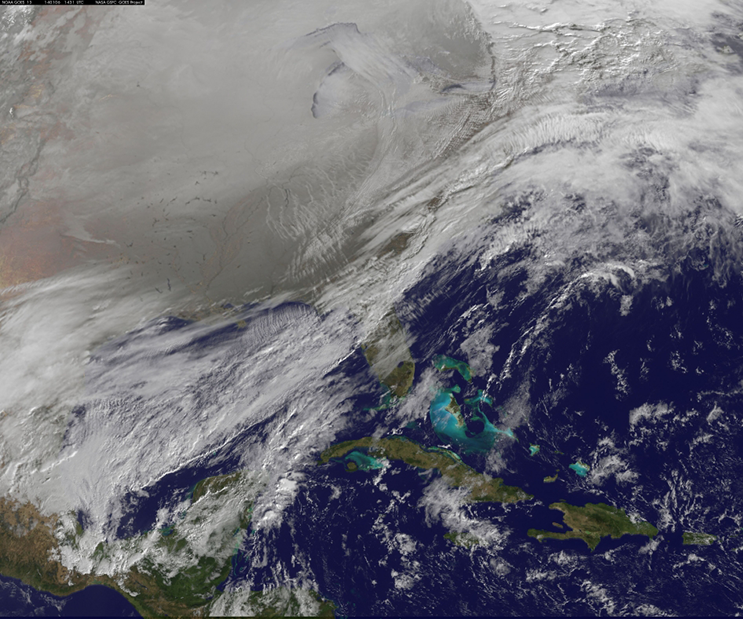
Two years ago I posted "Budget Time Travel : A Photographers Guide" explaining the notion that, at least in sorts of latitudes where I live, winter photography can transform familiar, well worn scenes into something other, providing the photographer willing to brave the cold with an alternative to long distance travel in order to find fresh subject matter. That was written during the winter or 2014-15, the second year in a row in which a weak polar vortex failed to keep arctic temperatures confined to the arctic, allowing them to run amok over the eastern half of North America including the Great Lakes region. Last year though the term 'polar vortex' which was becoming oh so familiar was replaced with 'El Niño', and with it came more mud than snow. While this was a relief in just about every other way, it didn't make for much photographically.

NOAA/NASA GOES Project Image
So here it is, mid-December 2016 and for the third time in four years we're hearing about the polar vortex again. Really I've been hearing the term bandied about since the summer, usually in discussions that started with the old "they say it's going to be a nasty winter" without any mention or probably even conception about exactly who or what "they" are. It wasn't really until just this week when a normal, possibly even warmer than normal autumn suddenly gave way to mid-winter conditions that I took much notice. Not that I or anyone else who lives in this part of the planet had much choice if they had any plans involving stepping outdoors.

As this cold weather snap coincides with that time of year where days are so short I drive both to and from work in the dark it wasn't until yesterday I had some free time during daylight to take advantage photographically. Given this is also the time of year for holiday preparations it was not a whole lot of time though, so with time constraints I decided to stay in town and make the most of my favourite local well trodden subjects, a decision it seems that turns out to have been the right one.

Take the lead image for example. Some readers may recognize the subject as that same crumbling break wall that was featured in my post almost exactly a year ago in "One Subject, Many Approaches II". It also appears in the post just previous to this. Other than being some structure jutting out into the water, with its thick coating of ice it seems almost unrecognizable here. I had actually headed out the door on bright sunny morning to do some shopping but noticing the heavy band of clouds hanging over the lake turned around and collected my Mamiya gear. It was only in the last few hundred metres of my drive out to the lake that the sun became obscured by cloud cover. That came as a bit of a disappointment as I'd been hoping to capture a dramatically sunlight foreground to make the dark clouds over the lake seem even more dark and ominous but looking at it now that might have been too much contrast. The clouds are plenty dark on their own. It only got cloudier the longer I stayed and before long I was having to take measures to keep the falling snow from collecting on my equipment.

I made the mistake of leaving without a good cable release. I had the $5 cheapie that sits at the bottom of the pack as a spare but after an hour or so in the cold that came apart and with the diminishing light as the once distant clouds moved overhead started bringing exposure times uncomfortably low to manually release even with the tripod I decided that shopping I had shouldn't be put off too long. I did manage to slip out again later that afternoon just to finish the last half of the roll that was in the camera.

I guess it's possible that this cold snap may be just the prelude to an otherwise normal winter. If so I was glad I got this chance and there will no doubt be a few more notable days before the season gives way to spring. On the other hand given how things so far are right in line with what the meteorological pundits have been saying, and experience with other recent winters, this may be just the tip of the iceberg.

Finally, for your enjoyment, here's some more from my first photographic foray of the new winter:


Thursday, 31 March 2016

A winter of... meh

Taken with the Bronica S2a with a 75mm Nikkor-P lens with an orange contrast filter on Ilford HP5 Plus.
Last year I wrote at length of my photographic revelry during the winter of 2015, a year in which Lake Erie came very near to freezing over completely. I noted how winter, at least at my latitude, can transform a landscape that was feeling a bit photographed out into something altogether fresh, and how I was therefore looking forward to what the winter of 2016 would bring. Well, it looks like for the most part El Niño put the kibosh on that idea as Winter really only put in a few token appearances this year. 

I was perhaps being a bit too optimistic in my hopes that this year would be anything like last. El Niño aside the consistently frigid temperatures of the previous year certainly seem to have become more the exception than the rule these days. But although the ground remained conspicuously un-snow-covered much of the time, there were still those token appearances, temperature drops lasting the better part of a week that, while they were too brief to produce the grand ice desert landscapes of the previous year, did bring about a few situations that wouldn't occur at any other time of year.

Case in point is the image up top. The glazed structure in question is part of concrete remains of the long abandoned Erie Beach Amusement Park that is my default destination when I'm not up for a drive out of town and don't have any better ideas. The doorway here leads into a sort of concrete room of sorts that served who knows what purpose back in its day, which is at one corner of a sort of sea wall that encloses about a hectare now overgrown with trees and cat-tails for, again, who knows what purpose. On brighter days it's possible to see to the bottom of this "room" to a floor of rocks and broken concrete, along with the occasional beverage containers and other artifacts suggesting periodic exploration by those presumably much younger than I. Photographically it's always been a bit of a challenge to me in that it seems like something that should be more interesting than any of the images of it I've come away with.

On this day however the combination of strong winds and a particularly brutal (at least in context of this winter in general) snap of cold had transformed its gratified concrete walls into something other-worldly.  In a colder year in fact it's something that wouldn't have happened at all as it wouldn't have been possible for the wind to spray the surface with water, which then froze, had the surface of the lake been frozen over. Those wild conditions had happened the night before. Things were nice and calm the next day when I got there, a few somewhat eerie clouds having moved in to compliment the mood. As you can no doubt guess rendering them as such required no small amount of burning in, accomplished here via Photoshop as the darkroom has become temporary storage through the winter while work has been going on elsewhere in the house. I'm guessing this is something a lot of home darkroom practitioners out there would relate to.


If the story of cold combined with strong winds on Lake Erie coating things with ice this passed winter sounds familiar it may be due to an image that widely circulating around the internet last January depicting a car frozen in place and completely covered over in a layer of ice. This happened in Buffalo NY, just across the way from me and, surprise, was the result of the same set of circumstances that gave that car its frosty coating. I somehow doubt that my image will make its way around the internet to the same extent. It's a shame too because, while I'm admittedly biased, I think mine is the better photograph.

Monday, 9 March 2015

Sun and Snow


In fairer seasons those perfect cloudless days can do as much to elevate my disposition as the next person. If such a day also so happens to be free from work obligations it might be the perfect time to do a bit of token work around the house followed by some less demanding social/recreational activity. Whatever that activity might consist of it probably won't involve throwing a tripod and bag of camera gear into the car and heading wherever fancy takes me. Those sojourns are usually reserved for days that promise more mood, more drama than harsh sun and empty skies are likely to deliver. A thunderstorm wouldn't be out of the question if I could keep the kit dry. I've avoided shooting in direct sun so much at times I wonder if I've undergone the photographic equivalent of going Goth.

That's the way of things over the past couple of years at any rate. In earlier times, not long after I had really started getting a handle on black and white and darkroom printing, it was more about detail and texture. My images tended to be more abstract and I printed them with a mind to achieving a full tonal range from near paper white to the deepest black that could be achieved. Back then skies didn't figure quite so prominently in what I was shooting and full sun just meant going out early or late enough to get some dramatic side lighting.

I haven't abandoned that approach really. It's just for the past couple of years I've been inspired by different things. Lately though it seems some of that old inspiration has been making a re-appearance and I think it's due in large part to snow.

I couldn't tell you the year this was taken other than it was sometime in the early to mid 90's, but somehow I recall the date was March 7th. It's a good example of the kind of work I was doing back then, both in the field and in the darkroom. I'll be a happy fellow once I feel I have back the kind of darkroom chops I had in those days. (Camera: Arca Swiss F line 4x5, Lens: 210mm f/5.6 Schneider Symmar-S, Film: Probaby T-Max 100 but don't quote me on that, Paper: Ilford MG-IV FB.)

Snow makes itself into new objects, creating forms of its own. It blankets the messy ground with a clean white canvas, ready to be painted with shadow, isolating objects that break above its surface. It can be specular, translucent or take on multiple textures. So many of its more photogenic aspects however require sun. Without it snow is often just a bland featureless cover hiding the landscape beneath.

 So it is that through the course of this particularly snow graced winter that the sun has again started to factor into my photography as more than just a source of dramatic back light for moody clouds. I've started to work with once more, even anticipate it.

At least that's how it's been to this point. We've moved on into March now. Last week temperatures got above freezing for the first time I think since December and since then has been wandering even higher above that mark with increasing regularity since. Winter may yet have an encore or two in store but it won't be long before snow cover is cleared out in a spring liquidation and I'm trading in my Kodiak boots for a pair of wellies. Bountiful as this winter has been photographically part of me is all too ready to get on with it. (And I must confess, it's the greater part.) Whether this rekindled working relationship with the sun in all of its unveiled glory continues when this happens, well... we'll just have to see.

This section of what is collectively known as Niagara Falls is one of only several hundred waterfalls across the planet to go by the name "Bridal Veil Falls". It baffles me how often it's failed to occur to anyone that as virtually any waterfall resembles a bride's veil that this isn't a particularly distinctive moniker. 
The out flow from the now defunct Canadian Niagara Power generating station. The water keeps flowing for free and the generators are still sitting there doing nothing - seems like a waste not to turn them on just because they're old.
I didn't notice until I decided to touch up a few dust spots the big blob of lens flare sitting in the branches towards the upper left like a big icy coconut that had somehow just grown there. 

Thursday, 12 February 2015

Budget Time Travel: A Photographer's Guide

The surface of Lake Erie, February 2015. Perhaps if one were to visit this exact spot in another two million years or so it would look quite similar, with sand and rock standing in for the snow and ice seen here.

If you've been following this blog for any length of time you'll know I belong to that large group of photographers for whom location and subject are usually one and the same thing. In order to have some measure of variety in our work travel is a virtual requirement, though for myself and others with similar restrictions on time and finances this need not involve a globe trotting lifestyle.

As I was in the midst of shooting the images featured in today's episode, my mind as usual wandering a different landscape than my body, it occurred to me a photographer could bring similar variety to their portfolios if we could travel in time rather than space, zooming into the future and watching the landscape change around them. Seasons would pass before our hypothetical photographer's eyes, bringing a lifetime worth of change in only minutes. They might grab a few shots as whatever apocalypse eventually befalls us all passes by in time lapse quick time then watch as the forces of climate and geology transform the landscape, perhaps turning a sea-side vista into a desert.

White on white subject matter in not particularly contrasty light made for some pretty flat looking negatives. On the light table the last negative taken on a previous day on the left and the shot taken just previously to the above image above on the right, side by side on the same negative strip. Contrast is fairly easy to adjust in a scan but it should be interesting to see what it takes to print this in the darkroom.


I do travel through time of course - forward only at the rate of one minute per minute like everyone else. I might hope for epoch spanning powers, but alas yet another Christmas has come and gone and once again no Tardis under the tree for me. But if the ability to zoom back and forth through time still eludes me there are times and places where nature transforms a landscape so rapidly as to present the illusion of the passage of geological ages in the course of just days or weeks. Though such occasions often follow in the wake of floods, volcanic eruptions or other such disasters, the trigger may be as benign as a change of seasons. And if you're lucky enough to live by one of the Great Lakes, especially Lake Erie (the shallowest and therefore first to freeze) all it takes is the onset of a solid winter.

In a way this is really the third installment in an unplanned series that started with Embracing the Elements and A Follow Up Visit. The images are from my second follow-up visit made in the first week of February. The location once again is my usual lake shore stomping grounds which, somewhat ironically perhaps, was once the site of a popular summer resort. It's where I go when I don't have much time and don't feel inspired enough to look for something new to photograph.  As you can imagine, under normal circumstances it's getting hard to find anything fresh to photograph, but a winter like this transforms it into a whole new location. A few weeks of cold weather is all it takes to transform my sea side vista into a desert landscape so long as you don't mind the fact the ground is covered by snow instead of sand. (Actually, in a whipping wind with temperatures in the -15oC neighbourhood, I did mind just a little.)

A shot from the Nikon F80 equipped with a Tamron SP 20-40mm lens and a yellow filter. I didn't have much choice about the filter as it, along with the red filter I attached the Mamiya's 50mm Sekor lens, wouldn't budge once I screwed it on until I got home and everything warmed back up. 


Equipment wise I brought my usual RB67 kit, this time bringing my Nikon F80 sporting a Tamron 20-40mm zoom as a side arm. Obviously I'm not using the Nikon enough as the roll of Ilford Delta 100 I managed to finish that day bore a few family photos that were obviously taken last summer. By the sound of things its built in auto-wind motor was obviously struggling in the cold, and doubly so on the rewind, but it soldiered on admirably and the resulting negatives were none the worse for it. The cold also affected the film back on the RB67 as the mechanism became sluggish resulting in its failure to register that the film had been wound meaning the double-exposure prevention had to be overridden. Of course this meant I had to pay careful attention to avoid double-exposures or accidentally skipping over frames. Not the easiest thing for me. As we've seen, my mind wanders.

There will probably be more winter photography to come over the remaining weeks. The replacement spot meter arrived today (see the previous post if you missed it) and I have some time off over the next couple of days to try it. I also have hopes that some of winter's more unique conditions will coincide with a time I'm free to get out there with a camera. It has to happen sooner or later. Still, if it so happens I don't squeeze off another shot until spring I can comfort myself with the thought that this year already winter isn't another season I let get away.


Wednesday, 28 January 2015

When The Tourists Are Away...

In past entries I've noted how, as a local, Niagara Falls doesn't have the sort of magnetic draw on my camera lenses that seem to hold sway with visitors to the area. For the past several years however it's been my intent to visit during the much more photographically interesting and visitor sparse height of winter. Past years have not been kind to my plans. Last year I let the unusual cold take away my photographic mojo which only returned when things warmed up, and the several years prior to that were too warm for there to be a real dead of winter.

It didn't occur to me at a time but coated and weighed down by ice this tree reminds me of a Shetland Pony.

Though not quite so frigid as last year, this January has been accompanied by some solidly winter weather, and with my mojo fully intact I finally set out to ensure another year wouldn't pass without getting a crack at the area around the Falls. It wasn't so much the Falls itself I was after, though they too take on added interest in the presence of great quantities of ice. The real draw was the heavy glaze of ice that covers almost everything in the surrounding area. The mist rising from the torrent below that in warmer months drenches countless unprepared tourists begins to freeze on the surface of anything that doesn't move as the temperatures drop, turning trees and other fixed objects into virtual ice sculptures.

I brought what has become my standard kit - Mamiya RB67 Pro S with all four lenses for it I own, 50mm, 65mm, 127mm and 250mm, three backs loaded with Fuji Acros for black and white, Kodak Portra 160 for colour and a roll of 35mm Ilford Delta 100 with my home made 120 adapter for panoramas, Manfrotto 055 tripod, light meter, and the usual sundries like filters, cable release etc. I also brought along the Minolta Hi-Matic 9 loaded with some Fuji Superia 400 I've kept in the freezer for about ten years. As I write this I have yet to finish off any of the colour rolls I was shooting that day so images from those are yet to come. Also, as the 35mm roll in the RB67 back had been a partial roll, I was unaware that there was only one frame left and since it has to be unloaded in the darkroom when finished I was unable to reload in the field. 

These windows are part of an odd looking rail-car, the purpose of which I can't guess. It's enclosed in its own little fenced off enclosure suggesting it has some sort of historical value. It has plenty of character and I'd love to explore it with a camera more but the fence itself gets in the way. I was able to see a bit more this day though by standing on a show bank.


If rainbows in b&w are not your thing I did get a colour version of this which you may see once I finish the roll.


As anyone familiar with the RB67 will realize this is quite a load, but my middle aged, desk job soft self can still manage a haul of a few KM over reasonable terrain when I've got it all loaded into the big photo backpack. That's pretty much what I set myself up to do when as usual I chose the free parking at the Dufferin Islands park and walked the rest of the way. I might have saved myself some effort had I realized that not only was this normally heavily maintained area neglected in the off-season, and that likewise they don't bother maintaining the tourist premium parking rates closer to the Falls when there are next to no tourists arriving. Though I could have avoided the slog, it's over now and I burned off all those extra calories.

If I had it to do over again, and with at a good month or more of winter yet to come I guess I do, I think I would have been better served if I had left the Mamiya at home in this case in favour of a Nikon used hand-held. Shooting tripod mounted is almost habitual for me but in this case I felt it held me back from exploring all the compositional options I found myself confronted with. I was glad of the Hi-Matic I brought with me, allowing me to be a little more free-wheeling though with one of the Mamiya backs loaded with Portra I found myself wishing I had loaded it with black and white film.


The one panoramic image I was able to get on 35mm film adapted to the RB67. As I had no idea how many shots were on the partial roll to begin with there was no way to know that there was only one exposure remaining and as it had to be removed in the darkroom I couldn't put in a fresh roll in the field.


Matters of shooting style aside however, this was one day that using a waist level finder, currently my only option with the RB67, put me at a disadvantage. This isn't always the case, and in fact there are times when using a waist level finder has been a revelation. For example landscape shots featuring a prominent foreground object often require shooting from an angle low enough to have an eye-level finder user crawling on their belly to frame up the shot. Even when the shot doesn't require such low angles, shooting with a camera held at chest level rather than the same height we are used to seeing the world from can subtly add interest to images through the slightly unfamiliar point of view. Putting my armchair psychologist hat on the lower eye level implied may even be suggestive of a child's point of view, triggering whatever emotional responses that might involve for a particular viewer. This waist-level point of view has been noted as an important component in Vivian Maier's style. Perhaps the child's perspective would also make sense in the work of the word's most (belatedly) famous TLR toting nanny. 

There's a flip side to this of course, as obtaining a perspective higher than waist-level requires a step ladder or some reasonable substitute. For example, in image at the top of the post I was aware that the top of the tree intersected with the top of the falls and that I could remedy this by raising the height of the camera but as I need to look down on the camera from above to see what was in the shot, doing so would have left me shooting blind. Like most medium format SLRs the RB67 has interchangeable viewfinders and I have considered getting an eye-level finder for situations like this. Of course to really benefit I'd have to bring along both finders and switch as needed, adding yet another item to an already heavy pack. Not as heavy as carrying a step-ladder with me mind you, so I may yet do this.

There are more images to come. The images here are from the first roll of Fuji Acros that went through the Mamiya as well as the aforementioned single panoramic image on 35mm film. In addition to the colour images still in camera there's a second roll of Acros with images from that day that's also waiting to be finished. As always I'll keep you posted.  

Wednesday, 14 January 2015

A Follow Up Visit

I have a day job. The standard two days off a week that might or might not end up being the sort of days that inspire photography if indeed none of life's little obligations has me otherwise committed. If I'm not careful an entire season to pass with almost no new work to show. After letting last winter go by this way I'm hopeful the outing I wrote about in my previous entry Embracing the Elements marks the start of a more productive season this year, establishing a bit of momentum as it were. 


So it was a few days back that an unexpectedly heavy winter blast and accompanying highway closure gifted me with an unexpected day off I felt the opportunity accompanied by a bit of pressure to keep the ball rolling by taking photographic advantage of the situation. This was enhanced by the fact that by the time I had the driveway clear enough to go anywhere the morning light along with the peak of the freshly fallen snow look had both deteriorated into something less photogenic. It was turning into an unremarkable day with some not quite so virgin snow all around. Something could still come of that, you never know, but the slight sinking feeling in my gut told me the best part of this opportunity had already slipped away, taking some of that momentum with it.

Hoping things would get interesting later on when the sun started getting lower again I let the missus talk me into an early afternoon grocery run accompanied by my thirteen year old daughter who was also enjoying a bonus snow day. Still, nagged by the sense I was letting a free photo day get away from me, setting an unwanted precedence along the way, I was at least careful to bring the backpack containing my take-everywhere Iskra along for the ride. Good decision. While skies overhead were just plain bland, from the shopping centre which is much closer to the lake I could see conditions over the water were much more interesting, resembling those I had experienced a few days before when I had gone with the whole RB67 kit in tow. Though today I had only the Iskra and my captive passenger (who offered no words of protest, bless her) it seemed a return visit might be fruitful.

Part of my motivation was simple curiosity about how much things had changed out on the lake. On my first visit I was taken by surprise at how much had already frozen over after an unusually warm December. On this day the ice went out much further still so that an elevated vantage point was required just to see open water. The first thing that struck me was that the ice hills that seemed so massive only a couple days before now seemed rather flattened. This was a bit of a disappointment as on my previous visit it seemed they could easily be worked into some interesting compositions but I passed them up in favour of finding a vantage point that would allow me to include open water in the composition without undue risk of an unplanned polar bear swim. Shrunken as they now appeared the potential they seemed to have earlier was lost.

Knowing this return visit would have to be shorter (what with the attention span of teenagers these days and all) I stuck mostly to the promenade, seeing things from the same perspective I had seen them from a hundred times before, except that with the ice they were not the same things. The sky, while just as interesting, wasn't quite the same as it had been last time either, containing enough blue this time it seemed filters should effectively enhance the look whereas last time everything appeared too monochromatic for filters to matter. I carry contrast filters in my backpack too. I stuck on a nice orange one and left it there.

It was a bit off the cuff, playing with composition including sky and barren trees, sky and not quite so impressive as they were a few days ago ice hills, sky and tag along teens. Handheld shooting isn't my usual M.O. and though it didn't seem like I was likely to get any real keepers it was still feeling worth the effort of coming out. If nothing else I wanted to finally get a new roll of film through the Iskra. The one I was shooting was loaded months ago after I had improvised a few light seals to address a few leaks that had appeared and I was still unsure if the new seals were effective. As we headed back to the car I still had two frames left, which turned out to be perfect. Passing an old concrete structure I had photographed dozens of times before, a deteriorating room sized stand that had once served as a base for some sort of tower back in the amusement park days, I noticed the most unusual combination of sun behind a semi-translucent bank of cloud. The strange appearance was helped by the fact I was wearing my honey tinted polarizing sunglasses, an effect I hoped the orange contrast filter would help me match on film. A small voice inside was protesting, as it usually does, at yet another photo of that old cement thing, but from this vantage point and half buried in ice as it was the shot would be unique and the voice was once again over ruled and I used up my remaining two shots on the roll.

The result is at the top of the post. It was better than what I imagined my little return visit would result in, and I think I like it more than anything I got the first time out with the RB, its full retinue of lenses and pretty much the whole day to shoot. Of the two frames I got only the first really caught the effect I was after. By the time I shot the second that just right blend of cloud transparency and sun was already disappearing. Oh and the other good news - no sign of light leaks.

In the end any sense that I had let any opportunity slip or lost any momentum was gone. Prospects for the rest of the winter still seem pretty bright. It remains to be seen of course, but whatever the case, I'll keep you posted.


Thursday, 8 January 2015

Embracing the Elements

I expect things to slow down this time of year but somehow between the holidays and getting hit with that flu that's been going around it's been a month an a half now, which I didn't expect. With both of these things winding down now that just leaves the cold to contend with. The cold is an obstacle that last year all but brought my photographic activities to a halt, but it's also an opportunity so I've vowed that this year I won't let winter stand in my way, at least not to the same degree.


Winter changes everything. At least it does where I live and for most of you living at roughly similar or higher latitudes I presume it does for you as well. The land takes on a new character. Favorite subjects you/ve photographed too many times in the past can take on a new look. Scenes that might not have looked like much amid the cluttered overgrowth of warmer seasons are transformed by the barren cold and a fresh coat of snow. Even the snow and ice itself can become the subject for photographs that exist at no other time and may never appear quite that way again.

 If you're fortunate enough to live near one of the Great Lakes, winter offers another opportunity that exists in only a few other places in the world. The Great Lakes, any of them really, are a bit like little fresh water oceans. The the lakes are vast enough to be photographed as seascapes, but being fresh water, when winters are cold enough vast quantities of ice accumulate along the shore forming temporary desolate landscapes that differ from year to year.

It must of course change quite a bit over the course of a winter, but having always lived a few minutes drive from the shore I've never really gotten the sense of how it might change on a week to week, even day to day basis. This year then I resolved to visit the shoreline throughout the winter to see how things change, and of course take advantage of whatever photographic opportunities such changes might present. Only a few days into a cold snap following a green and rainy Christmas I made my first jaunt out to the beach yesterday expecting to see little more than the first hints of a line of ice clinging to the shore. Apparently I had the whole thing figured wrong. When I arrived at my usual haunt, the stretch of shore strewn with the ruins of the old Erie Beach Amusement Park, the ice had already created a new landscape of low wind blown hills extending perhaps a hundred metres out from shore. I had been hoping for less really. I had imagined getting images that included ice and water but the new shoreline was 100 meters further on across ice I knew better than to attempt to cross however thick it might appear.


After wandering around for quite some time and making a few exposures I didn't imagine would amount to much I finally found that it was possible to follow the old concrete pier that, back in the heyday of the amusement park had received visitors arriving by boat from Buffalo NY. Here I was able to get my seascape compositions complete with ice in the foreground I had in mind. The greater than expected volume of ice at last seemed like a bit of a bonus as it gave an Antarctic feel to the scene.

I don't put much stock in long term forecasts so I'll take the winter as it comes, which is my default plan for most things anyway. In any case there is more to watch than just what happens along the Lake Erie shore. There's also the Niagara River including the Falls and all the surrounding things mist might freeze to. Then there's all the streams, creeks, woods and so on. It just takes the time and, when the temperature starts to drop, the will.