Showing posts with label Lake Erie. Show all posts

Sunday, 3 March 2019

Colour Conundrum pt. 1: "Kodak 5"


Colour Photography and me, sometimes I just don't know. It isn't that I have issues with it as a creative medium. Sure, black and white is it for me 90% of the time but there are times when colour is an important element. The trouble is more of a practical thing. It's easy enough to carry and extra back loaded with colour film for just those occasions. The problem is what to do with the stuff once it's been shot. Gone are the days when it was a simple matter to find a local business that could handle the processing for you. The answer should be simple enough - I know my way around the darkroom (I can do it with my eyes closed!) and colour chemistry isn't that hard to get my hands on. The trouble is a batch of C-41 chemistry only lasts for a couple of months once mixed. On average over that time span I'll probably not even shoot a single roll of colour. If I were to shoot E-6, which I'd love to, that's even worse. 

A popular option these days is to ship film away to a lab but shipping one roll at a time adds a lot of expense and if I'm going to wait until I have several rolls I might as well just do it at home. I have all the stuff after all. And so it is this is the option that I have gone with. Sounds like a near perfect plan given the circumstances, right?

Well... maybe. I'm no stranger to the C-41 process. It's fixed, predictable if you stick to a few simple guidelines with no adjustments required in time or temperatures to match a particular film, they all get processed the same way. In many ways it's easier and faster than processing a typical black and white film. Still, for reasons I'm sure had little to do with problems or inconsistencies at the development stage, recent results have fallen a little outside what I was expecting.

To begin with I had 6 rolls of film to develop: One roll each of Kodak Portra 400 and Ektar in 120, two rolls of Agfa Optima 400 in 220 that expired some time in the late 90's, a 120 roll of Lomo 100 and a roll of Fuji Superia 800 that went though one of my Nikons though I can't remember which. Together these represented all the colour film that that completed it's journey through my various cameras roughly over the past year, though in many cases they seem to have been sitting in camera for a much longer time than that. All were developed in the same batch of a 1L Unicolor C41 kit that I ordered from the Film Photography Project. It was recently mixed though I had the kit sitting around as dry chemicals for about a year and a half which should be well within expected shelf life for the unmixed chemicals. This is a two part series and here I'll be discussing the results from the Kodak emulsions and I'll follow up next time with some thoughts on all the rest.

Given that these were the most mainstream of the emulsions and, except for the Lomo, the freshest, these films gave me the most surprising results. Both of these went through my RB67. Like the other two medium format SLR systems I own it has interchangeable film magazines allowing me to switch mid-roll from one film to another and I've used this capability in the usual way to switch from the usual black and white to colour film when it seems appropriate. For the record it has always been a consistent performer the black and white images I have made with it come out just fine.

Portra 400

The Portra 400 had been loaded into the camera no more recently than 2015. I know this only because it contains a particular image, the black and white version of which first appeared in my portfolio in that year. There were only 4 (out of a possible 10) shots on the roll but it's been so long since I shot it I can't remember what might have happened that it was never completely shot. That's just how seldom I use that camera to shoot colour. For all the time it's been sitting there it's still surprising that there were such obvious issues with it. All of the images showed some degree of odd mottling. The first image was by far the strangest with a series of discoloured lines running the width of the film. Here's the straight scan:


The remaining exposures weren't nearly so affected but this odd mottling was evident in all of the exposures. Yes it's been sitting around for a while but I've developed film much older than this, including some that I'll discuss in the next instalment that was developed at the same time in the same batch of chemistry without any such issues. It's hard to say what's causing this. It's clearly not any sort of light leak as it seems to be just a variation in colouration and is worse on the first frame that would have been sitting closest to the centre of the exposed roll. One clue might come from the last of the 4 frames in which the otherwise random mottling shows one clear pattern. A cropped in image of this should make it plain enough...

And in case it's not clear where this might have come from here's a portion of the backing paper from that same roll:

I can only guess that this is the result of some sort of chemical reaction with the ink used to print the frame markings on the backing paper though curiously, to me anyway, there are no markings on the backing paper to match the lines seen in the first frame. Maybe the readership has some better suggestion?

I liked this final frame though, so just I decided to take the scan and clean things up as best I could digitally. The "Kodak 5" was gotten rid of easily enough but you don't have to look too closely to see the mottling.  If you can ignore this though I'd say I like the shot


Ektar

The second film that had gone through the RB67 was a roll of Ektar 100. It came out of the camera several months ago. If there were thoughts that the issues with the roll of Portra might have had something to do with whatever the problem must have been that caused me to shoot less than half of it most were dispelled by comparing it with this roll. Though it hadn't been sitting on the shelf nearly as long as the Portra, it also had a random mottling pattern throughout the roll and here the first three frames were plagued with particularly prominent lines that again spanned the width of the film, and again it was the same sort of greenish discolouration. Here is the third frame from that roll.


Image anomalies aside though it seems to me this roll came out much differently than any of the others. Ektar is known for it's reasonably bold colours but these seem punchy beyond reason to me. I mean it's still a fairly standard film not unsuited for standard portraiture. For example, while I'm no geologist I'm sure the rocks in this images are practically identical to the ones in the example Portra image above it that was taken about 30km away along the Lake Erie shore. They certainly don't strike me as being this sort of Mars red when I look at them. Curious indeed.

If Kodak C-41 films were generally problematic like this then I'm sure my experiences here would be old news. On the other hand if something is wrong on my end like I got a bad batch of chemistry or maybe I've just really gotten out of touch with good colour processing practice then you'd expect these problems to carry over to the other rolls I developed in this batch as well. In my best go at creating a cliff hanger then, that's what I'll look at in the next instalment so please stay tuned.


Saturday, 9 April 2016

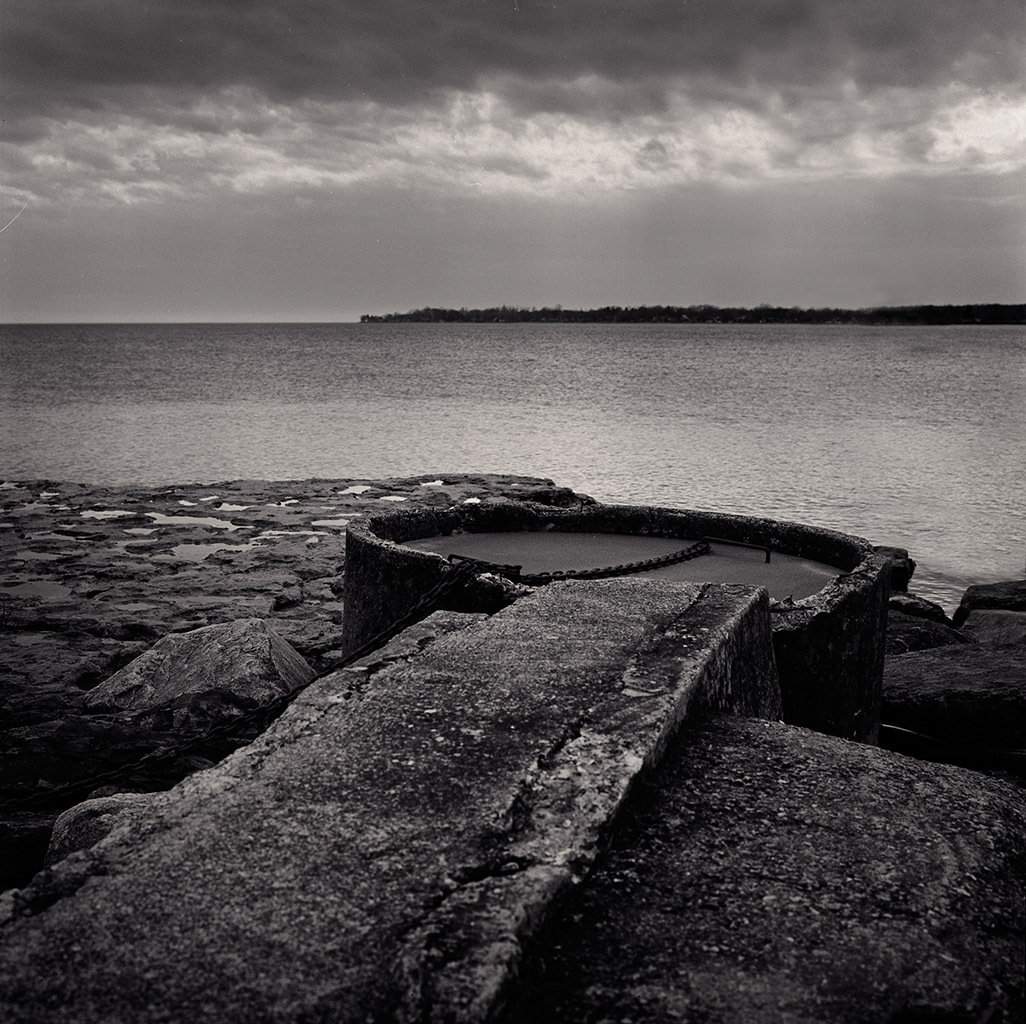
The Lake Is A Lie


Here's a lovely little image taken from a rocky beach along the shore of Lake Erie that I had such high hopes for. It had been a bland day up to shortly before this image was taken, the textureless overcast of morning having gradually given way to a cloudless blue above without even that brief transitional play of cloud and light to provide visual interest to anything above the horizon line. It was only by virtue of a long standing inability to learn when to give up that I was still out there at all when a lucky cloud bank rolled in, providing about a half hour or so the conditions I'd been wanting for all day. In that time I fired off the remaining half of the roll I had been working with all day to that point and made a fair start on another. The entire day of wandering aimlessly with a camera had been worth it after all.

Or so I had every reason to believe up until the moment, later that evening, when I pulled the roll off the developing reel in order to hang it to dry. It was only then that I learned the sad truth, a truth that means, lovely as this image may seem at first glance, it will never see the light of... well, an enlarger lamp. Things are not as they appear here.

You see friends, the lake is a lie. What you see is the result of a not particularly meticulous Photoshop rescue of a painfully ruined image, unrescuable by standard analog means. Worse, it is the result of problem that affected exactly those images that were taken during that half hour I thought had been the day's salvation.

Here is the photograph I actually took...


The culprit... a piece of plastic film that formed part of the light trap for the dark slide slot of the film magazine. I would assume that on inserting the dark slide I had pushed it loose so that it jutted into the image area, where it appeared on all subsequent exposures until I discovered the problem. Not wanting this to be a total loss I spent about a half hour fooling around with the rubber stamp tool, magic healing brush and the like until I convinced myself I had something passable enough for the casual once over the image would get when posted online. Knowing the truth of the matter though I don't imagine you'll have much trouble spotting the flaws. I haven't had the heart to tackle several other hoped for masterpieces that were similarly ruined.

Once the problem was known I was able to take the film magazine into the darkroom and by feel find and extract the offending piece of plastic without even having to sacrifice the remaining exposures on the film which all came out fine (though honestly I just blew off the rest of the remaining frames on some so so images for fear that, if there were light leaks, I'd care about the images that were wrecked). Despite the damage the light trap has never the less performed adequately since with no hint of darkening along the edge of the two rolls that have gone through since. I was fortunate that a quick search turned up a fellow who sells complete light trap kits online, not just the foam but the little Mylar bit that came loose in my case. It arrived the other day but will have to wait until the next roll is through to be installed. If I hadn't found that neat solution I also found a DIY alternative suggested in a few online forums involving cutting a substitute plastic film literally out of film using the exposed and developed leader end from a 35mm roll, the part that usually gets cut off and tossed once the film is dry. It's a good idea to file away for the future - there's no guarantee ordering one will be so simple next time I need to redo the light trap. 

Arguably if I spent more time on this I could get a nearly flawless image, indistinguishable for all intents and purposes from what I would have come away with if that little piece of plastic hadn't come loose in the first place. I've spent far less time on this, after all, than I would normally invest making a decent darkroom print from a good negative. In theory a digital negative could then be made and contact printed in the darkroom yielding a traditional silver print. Don't look for it to happen though. It's not that I'm some some sort of purist, I have no principled objections. I just don't see myself ever having the motivation. There's plenty of other good images I could be printing. Why fake the lake?

The good news? That concrete drain looks like it's been there for a while. It will probably be there just the same when I go back, film magazine intact this time.

Thursday, 31 March 2016

A winter of... meh

Taken with the Bronica S2a with a 75mm Nikkor-P lens with an orange contrast filter on Ilford HP5 Plus.
Last year I wrote at length of my photographic revelry during the winter of 2015, a year in which Lake Erie came very near to freezing over completely. I noted how winter, at least at my latitude, can transform a landscape that was feeling a bit photographed out into something altogether fresh, and how I was therefore looking forward to what the winter of 2016 would bring. Well, it looks like for the most part El Niño put the kibosh on that idea as Winter really only put in a few token appearances this year. 

I was perhaps being a bit too optimistic in my hopes that this year would be anything like last. El Niño aside the consistently frigid temperatures of the previous year certainly seem to have become more the exception than the rule these days. But although the ground remained conspicuously un-snow-covered much of the time, there were still those token appearances, temperature drops lasting the better part of a week that, while they were too brief to produce the grand ice desert landscapes of the previous year, did bring about a few situations that wouldn't occur at any other time of year.

Case in point is the image up top. The glazed structure in question is part of concrete remains of the long abandoned Erie Beach Amusement Park that is my default destination when I'm not up for a drive out of town and don't have any better ideas. The doorway here leads into a sort of concrete room of sorts that served who knows what purpose back in its day, which is at one corner of a sort of sea wall that encloses about a hectare now overgrown with trees and cat-tails for, again, who knows what purpose. On brighter days it's possible to see to the bottom of this "room" to a floor of rocks and broken concrete, along with the occasional beverage containers and other artifacts suggesting periodic exploration by those presumably much younger than I. Photographically it's always been a bit of a challenge to me in that it seems like something that should be more interesting than any of the images of it I've come away with.

On this day however the combination of strong winds and a particularly brutal (at least in context of this winter in general) snap of cold had transformed its gratified concrete walls into something other-worldly.  In a colder year in fact it's something that wouldn't have happened at all as it wouldn't have been possible for the wind to spray the surface with water, which then froze, had the surface of the lake been frozen over. Those wild conditions had happened the night before. Things were nice and calm the next day when I got there, a few somewhat eerie clouds having moved in to compliment the mood. As you can no doubt guess rendering them as such required no small amount of burning in, accomplished here via Photoshop as the darkroom has become temporary storage through the winter while work has been going on elsewhere in the house. I'm guessing this is something a lot of home darkroom practitioners out there would relate to.


If the story of cold combined with strong winds on Lake Erie coating things with ice this passed winter sounds familiar it may be due to an image that widely circulating around the internet last January depicting a car frozen in place and completely covered over in a layer of ice. This happened in Buffalo NY, just across the way from me and, surprise, was the result of the same set of circumstances that gave that car its frosty coating. I somehow doubt that my image will make its way around the internet to the same extent. It's a shame too because, while I'm admittedly biased, I think mine is the better photograph.

Monday, 14 December 2015

One Subject, Many Approaches II

The Wall and The Bright Side of the Moon

This past summer I wrote a post called "One Subject, Many Approaches" where I looked back on the results over the years of my efforts to photograph the same subject I'd photographed many times in the past, all the while trying to keep the images fresh enough to avoid the creative dead end of making essentially the same photograph again and again. In this sequel episode I'll be presenting another one of those well worn subjects I keep returning to. It is the crumbling remnants of a concrete break wall that once helped still the waters for revellers at the long defunct Erie Beach Amusement Park. Now if that sounds a bit familiar it's likely because the original One Subject, Many Approaches centred on another ruin, the concrete base of a carnival swing ride, from that very same attraction of yore. It is just a quick jaunt, about 300 metres, from this disintegrating nautical structure that is the focus of today's episode, and it wouldn't be at all unusual for me to come away from a little afternoon stroll with images of both. 

Proximity aside however the number of appearances these two subjects have made in my photographic corpus can be attributed to two simple virtues both posses - I find them interesting, and they are convenient. If I only have an hour to kill, if I'm testing new equipment, if there's interesting weather or lighting conditions that could disappear anytime and I need to find a subject now, I know I can get something if I take the five minute drive to old Erie Beach. Still, it's hard to shake the notion that it's really too easy, an almost guilty sense that another trip out to the wall somehow falls short of doing something photographically worthwhile. In spite of this, I often come away with results that surprise me a little. Maybe it's just the low expectations I have for the results.

Here is one from my early days with the RB67, a time when I was still a bit giddy to finally own such a camera. I was smitten with the works of a host of photographers known for their work with long exposures. Lacking a proper neutral density filter at the time I would set up in the fading light of dawn when, if I timed it right, I might be able to make two or three exposures with shutter speeds of one then two then several minutes before they finally became unworkably long.

My first experimental roll putting 35mm film through the RB67, yielding panoramic sprocket hole images. Obviously I wasn't so careful levelling the camera but tilt the film a bit and it almost looks like I meant to do it that way.

An example of the classic leading off to the horizon composition I see as a metaphor for our ceaseless journey into an unknown future that beacons us to a destiny at once fearful and full of promise. Others have suggested images like this are straight up phallic. Hmpf... Freud.

Here's one from this past October that I could have included a few episodes back in The Cool Colours of Autumn. Not a great success but I was just a tad too late to catch just a brief few seconds when the setting sun burst through the clouds casting the wall in a bright warm glow. Even though I had the F80 set to auto focus aperture priority, by the time I realized what was going on and managed to compose this shot it had all but faded. 


There were days this year when water levels in the lake have been unusually high, the changing water levels at times seeming quasi-tidal.  Here a driftwood log serves as foreground interest as the wall, nearly level with the waves, is barely noticeable. There was a workman from the town at the beach that day who, seeing me pull out the camera informed me that I was too late, that there had been a rainbow out over the water that had faded away only minutes before. Looking at that cloud I can't I've lost that much sleep over not having arrived earlier.

Finally here's one from my most recent roll out of the Bronica S2A. Obviously water levels were much lower this time and I decided to chance a stroll along the wall itself. I had been out exploring new locations but with a bit of time yet to kill made a quick side trip on the way home to blow off the last few frames on the roll. Figuring I would travel light that day I left the tripod at home, an unusual choice for me. Regrettable as I could have used it here. With the short days the late afternoon sun was already beginning to fade on an already bleak day and shooting hand held forced a shutter speed/aperture trade off I just couldn't get the better of and I wound up sacrificing foreground sharpness I would have sooner kept. Negotiating the crumbling sections of the wall is a bit tricky to begin with and doing so with a bag containing prized cameras and lenses always feels like a calculated risk, It looks like I may have to do it again though.

Saturday, 14 November 2015

The Cool Colours of Autumn


It's perhaps only a small irony that we connect autumn, a season of cooling, with a palette of such warm colours as the green canopies above transform, taking on colours of flame which, even as they fade leave us with a warm earthy browns. I happen to be particularly fond of warmer tones;  I tend to favour them when making home decor choices, generally prefer my black and white prints to have a somewhat warmer than neutral tone to them and when I load up with colour film as I am wont to do each fall I imagine filling them with images dominated by warm earthy tones.

Often they are, but I'm often surprised myself at how often it's just the opposite. You may have noticed for example that the photo that accompanied "A Season for Colour" a few episodes back may have featured a small stand of trees with leaves in full yellow autumn glory, but these really provided a complimentary accent to the foreboding sky that occupies most of the image space with it's cool blue, tones that seem to speak of the months to come once the snow begins to fly. These aren't the images even I usually envision when I head out to do colour work at this time of year.

To me it seems this is a simple consequence of a being a predominantly black and white photographer with leanings toward the foreboding and moody set loose on the world with a colour emulsion. It's not that find myself ignoring what's in the camera and approaching what's in front of me the same way I do with the usual monochrome stock loaded. Except for those times when I may grab a camera on the way out the door to do other things I'm not committed to colour. There is always an extra film back in the pack when I carry either the Mamiya or Bronica system loaded with HP5+ or Acros and whenever a photograph to be made calls out for it, a not infrequent occurrence, I'll happily make the switch. I have to say there I rarely find myself in doubt as to which is called for, though there are situations when it seems either could work.

The image at the top is an example of this. Had I been shooting exclusively black and white that day I probably would have shot it more or less the same way. As it happens this was taken the same day I was testing out the Polaroid Automatic 220 that I wrote about previously. What I didn't mention there was that on that day a wicked wind was blowing up a minor havoc along the lake. As I emerged from the relative shelter of the nearby wooded path a few small breaks in the cloud was letting through the first rays of direct sun I had seen all day bringing a welcome drama to the wind whipped seascape. I was able to grab a Polaroid shot right off but the fast moving clouds meant I had to wait for another shaft of sun to bring the drama back again so I could get another shot with the Bronica. Good thing I did too because as fate would have it about 1/3 of the previous image I had done with the Polaroid ended up appearing in this exposure. Despite the distinctly un-autumn-like colour palette I think the sombre sky, weathered reeds and blustery weather so typical of this time of year make this an appropriately seasonal colour image.


One more example is this recent shot of my son Brennan. It was a bit of a side jaunt to the beach I took him on while running a few errands. Noting some rather interesting clouds before we left I grabbed my Nikon F80 on the way out the door. I can't say I was really planning to use him as a subject, but somehow he just belonged in the scene so how could I not? Now someone may prove me wrong, but I don't think too many would argue with the suggestion that it just wouldn't work the same way if he'd been wearing, say, a red hoodie. And though, yet again, the predominantly cool blue tones here hardly scream out autumn, despite the lack of any real queue I can point to here that gives away the fact that is image was taken in October rather than, say April, somehow there's still a sense of the season here. Maybe it's just me, because I know, because I was there. Maybe it's something else though, something about the lake, the clouds, the play of light. There are always things that can't be put into words. If there weren't we probably wouldn't bother with pictures.

Saturday, 8 August 2015

One Subject, Many Approaches


A recent image of this old concrete relic I have photographed so many times before. Though it's really what's left of a
century old amusement park ride, here it seems to take on the feel of a forgotten ancient temple.

You may recall that last week one of the images featured, the crumbling "legs" of a concrete structure along the Lake Erie shore, was yet one more image of a subject I have photographed many times before. It's in fact just one of several features of potential photographic interest along that local stretch of lake shore I've mentioned here so many times before. Useful as it is as a place I know there will be a few images to be made if I'm testing a new lens or camera, or when I just don't have the time to go looking for images further afield, the decision to head down there has long been accompanied by the sense of going for the same old same old, the photographic equivalent of having no better idea than to order takeout pizza again. Yet as often as I have revisited the place and as much as it seems I must have completely exhausted that crumbling heap of concrete as a photographic subject, I find myself surprised again and again when a new way of approaching this humble subject presents itself even when, sure I have all the images that old thing could ever warrant, I'm not really looking for it.

First of all they may be those of you wondering just what this concrete monstrosity is. To get to that though a bit of the history of that whole stretch of beach is in order. Currently known simply as Erie Beach Park, or occasionally as Waverly Beach to Fort Erie locals, the area was from the latter part of the 19th Century to around the start of the Great Depression the Erie Beach Amusement Park. The area included rides, a casino, dance hall, roller skating rink and of course swimming areas, drawing many visitors from the United States via a ferry boat that brought them in from Buffalo NY. It was superseded by the Crystal Beach Amusement park about 10 kilometres further west to which some of the attractions were moved, while what remained was left abandoned. In recent years there has been a restoration of sorts. The crumbling path of the old promenade has been revamped as part of the Friendship Trail project running parallel to the Lake Erie shore linking my home town of Port Colborne Ontario to Fort Erie where I currently live. Included in the revamping are a series of information panels that detail the beach's former glory and go some way to explaining the mysterious concrete remnants that are visible along the shore.

Information panels on the walkway overlooking what remains of the old
amusement park now provide context for the curious on the various ancient
concrete edifices strewn along the shore. 

This brings us to the structure in question. This platform, supported by four outer legs plus a central column is the central support for something I have only ever heard described as "the swing ride". There are several photographs of what this looked like back in its day, perhaps none more telling in terms of what you'll find there today as one of the images from the info panels from the walkway overlooking the beach.


From this image it's clear not only what the function of the structure as it appears today was, but also the original purpose of all the toppled concrete columns that are strewn about the surrounding area.  According to the panel this image was from the 1914 Shredded Wheat annual outing, 101 years ago nearly to the day. It also appears that water levels were dramatically lower in Lake Erie a century ago. The remains of many of the other features in this photograph are still visible today including the foundation of the fun house tower on the left and the old pier walkway in the background.

Though I've lived in Fort Erie for the past 18 years or so, and only grew up just a 20 minute drive up the Lake Erie shore, I really only discovered this structure for myself less than ten years ago. Though I had no idea what it was at the time the photographic possibilities it suggested were obvious enough right from the start, and I'm certainly not the first to think so. Over most of those years I thought of this as a subject I had already covered, no need to return to it again. Somehow I always found a reason to. Ansel famously revisited subjects like Half Dome many times and we are all the richer for it. Apparently he saw value in returning to the same subject time and again. Maybe I should relax a little and see what more I can make of this. It may be difficult to tell by the roughly chronological sequence of images I present below but the structure is crumbling year by year and it may not be long before someone declares it unsafe and it gets pulled down for good. I'd hate to realize then that there were other ways to approach it.

For completeness sake I'll start with one from back in my digital days. All HDR'd
up I remember being quite proud of it at the time. I dialed the colour saturation
back some and made the contrast a bit more realistic to make it presentable here. 
Even in my digital era film was still part of my repertoire. This is image is even
older than the one above, but shot on 35mm Kodak HIE infrared film. I thought
this film was long gone but recently found a roll at the bottom of the freezer.  
In silhouette with the old pier and the Buffalo skyline in the distance.

My favourite image from a long expired roll of Vericolor.

Under a November sky, the clouds of autumn seem somehow different
than at any other time of year.

Taken just this past winter when I was drawn to the beach by some mysterious
looking clouds, here it appears as though transported to a whole other landscape.


Saturday, 1 August 2015

Feet First 4x5

In our last episode I managed to find a plan to shoe-horn large format darkroom capability back into my life without too much disruption to the rest of the household. There's still a bit of work to be done on that front, getting the door fully light sealed and whatnot. It could have been done some time ago but after years of staring at 4x5 camera equipment there seemed little point in using I couldn't put off the urge to get shooting with it any longer. That situation only became more acute when I managed to pick up a 150mm Schneider Symmar-S lens for just under $150 US.


You may recall the post "Success at the Tinker Table" in which I detailed the unlikely triumph of my efforts to get the shutter to my 135mm Wollensak Raptar working again. That was fine for what I intended at the time, but now that large format may begin representing a significant portion of my work again some serious glass is called for. I have fond recollections of the 210mm Symmar-S I owned back in photography school. Whatever else I may have achieved photographically in the intervening years the most luscious prints I have ever made are from negatives made through that lens. Of course the more regular darkroom practice and toned fibre based prints I was making back then may also have contributed, but to me there is no doubt that the Schneider was the best I've ever owned. When finally some eighteen years ago changing life circumstances forced me to admit there was faint hope I'd ever have much occasion to use it again I regretfully sold it. While the Symmar-S series has been superseded in the Schneider line by Apo-Symmars and Super-Symars, it feels like a small, reassuring sort of home coming to see the name back in my photo backpack. 


The images here are from a quick little shakedown outing in the field. It was a simple jaunt out to the stretch of beach I've shown you images from countless times before, but as so often happens things were just a little different than they've ever been before. The inukshuks were the first surprise. Some ambitious individual or individuals had built half a dozen of these structures within about a thirty metre radius along the beach. The shot at the top was of the only one of these that both allowed me enough room to shoot and didn't have some horribly distracting element in the background. It was was just good fortune that I decided to go out that day as when I returned the next day hoping to get additional compositions using the greater selection of lenses I have with the Bronica outfit someone had toppled all but one of these.


The other surprise was the water level. While images of the Great Lakes can appear effectively ocean-like, they lack a proper tide.and the photographic variations that may present themselves as they go in and out. That said wind and weather do combine to alter water levels, and while in my experience it seems as though on average the shoreline has on average been creeping back a bit year to year, this year it has surged forward so that sections of beach I used to walk accompanied by shore birds have been reclaimed by fish. Though it's been a few years since I told myself I had photographed the concrete structure in the above image to death I keep finding new ways, and on this day I saw it for the first time in my own memory not as something 10 metres or more from the water, but as something coming out of the water. It was evening and light levels were getting low enough that combining the light lost through a red contrast filter with a small aperture setting allowed a 15 second exposure, enough to get a nice blur effect with the water to contrast the rough surface of the disintegrating concrete.

While I imagined my lack of a scanner that's built to handle large format negatives would bring the forced discipline that at the very least would compel me to make contact prints I must confess that I've become fairly proficient at scanning both halves of a 4x5 negative and stitching them together with software. While it feels like cheating it has brought a few issues to light. One is that the traditional 4x5 hangers I have been using to develop the negatives have resulted in a few issues that need to be dealt with. The first is that I have gotten some rather nasty scratches that appear to have resulted from the sharp corners of one of the metal hangers contacting the surface of the negative in one of the other hanger during processing. It's difficult, especially in the dark, to keep all the hangers together as a group when agitating or transferring to another tank and I assume this the problem. Another is that on some images I've seen density streaks, similar to those sometimes seen with 35mm film that line up with the sprocket holes, except these seem to match up with the holes in the sides of the film hangers that exist to let the chemistry drain away. If I don't find a solution I'll probably abandon the hangers and get myself a MOD54 unit and process in my disused Paterson tank, with the added benefit of being able to keep the lights on through most of the process. I'm sure there are many more lessons to come as well. In a way it's part of what keeps us all going.

Thursday, 12 February 2015

Budget Time Travel: A Photographer's Guide

The surface of Lake Erie, February 2015. Perhaps if one were to visit this exact spot in another two million years or so it would look quite similar, with sand and rock standing in for the snow and ice seen here.

If you've been following this blog for any length of time you'll know I belong to that large group of photographers for whom location and subject are usually one and the same thing. In order to have some measure of variety in our work travel is a virtual requirement, though for myself and others with similar restrictions on time and finances this need not involve a globe trotting lifestyle.

As I was in the midst of shooting the images featured in today's episode, my mind as usual wandering a different landscape than my body, it occurred to me a photographer could bring similar variety to their portfolios if we could travel in time rather than space, zooming into the future and watching the landscape change around them. Seasons would pass before our hypothetical photographer's eyes, bringing a lifetime worth of change in only minutes. They might grab a few shots as whatever apocalypse eventually befalls us all passes by in time lapse quick time then watch as the forces of climate and geology transform the landscape, perhaps turning a sea-side vista into a desert.

White on white subject matter in not particularly contrasty light made for some pretty flat looking negatives. On the light table the last negative taken on a previous day on the left and the shot taken just previously to the above image above on the right, side by side on the same negative strip. Contrast is fairly easy to adjust in a scan but it should be interesting to see what it takes to print this in the darkroom.


I do travel through time of course - forward only at the rate of one minute per minute like everyone else. I might hope for epoch spanning powers, but alas yet another Christmas has come and gone and once again no Tardis under the tree for me. But if the ability to zoom back and forth through time still eludes me there are times and places where nature transforms a landscape so rapidly as to present the illusion of the passage of geological ages in the course of just days or weeks. Though such occasions often follow in the wake of floods, volcanic eruptions or other such disasters, the trigger may be as benign as a change of seasons. And if you're lucky enough to live by one of the Great Lakes, especially Lake Erie (the shallowest and therefore first to freeze) all it takes is the onset of a solid winter.

In a way this is really the third installment in an unplanned series that started with Embracing the Elements and A Follow Up Visit. The images are from my second follow-up visit made in the first week of February. The location once again is my usual lake shore stomping grounds which, somewhat ironically perhaps, was once the site of a popular summer resort. It's where I go when I don't have much time and don't feel inspired enough to look for something new to photograph.  As you can imagine, under normal circumstances it's getting hard to find anything fresh to photograph, but a winter like this transforms it into a whole new location. A few weeks of cold weather is all it takes to transform my sea side vista into a desert landscape so long as you don't mind the fact the ground is covered by snow instead of sand. (Actually, in a whipping wind with temperatures in the -15oC neighbourhood, I did mind just a little.)

A shot from the Nikon F80 equipped with a Tamron SP 20-40mm lens and a yellow filter. I didn't have much choice about the filter as it, along with the red filter I attached the Mamiya's 50mm Sekor lens, wouldn't budge once I screwed it on until I got home and everything warmed back up. 


Equipment wise I brought my usual RB67 kit, this time bringing my Nikon F80 sporting a Tamron 20-40mm zoom as a side arm. Obviously I'm not using the Nikon enough as the roll of Ilford Delta 100 I managed to finish that day bore a few family photos that were obviously taken last summer. By the sound of things its built in auto-wind motor was obviously struggling in the cold, and doubly so on the rewind, but it soldiered on admirably and the resulting negatives were none the worse for it. The cold also affected the film back on the RB67 as the mechanism became sluggish resulting in its failure to register that the film had been wound meaning the double-exposure prevention had to be overridden. Of course this meant I had to pay careful attention to avoid double-exposures or accidentally skipping over frames. Not the easiest thing for me. As we've seen, my mind wanders.

There will probably be more winter photography to come over the remaining weeks. The replacement spot meter arrived today (see the previous post if you missed it) and I have some time off over the next couple of days to try it. I also have hopes that some of winter's more unique conditions will coincide with a time I'm free to get out there with a camera. It has to happen sooner or later. Still, if it so happens I don't squeeze off another shot until spring I can comfort myself with the thought that this year already winter isn't another season I let get away.


Thursday, 8 January 2015

Embracing the Elements

I expect things to slow down this time of year but somehow between the holidays and getting hit with that flu that's been going around it's been a month an a half now, which I didn't expect. With both of these things winding down now that just leaves the cold to contend with. The cold is an obstacle that last year all but brought my photographic activities to a halt, but it's also an opportunity so I've vowed that this year I won't let winter stand in my way, at least not to the same degree.


Winter changes everything. At least it does where I live and for most of you living at roughly similar or higher latitudes I presume it does for you as well. The land takes on a new character. Favorite subjects you/ve photographed too many times in the past can take on a new look. Scenes that might not have looked like much amid the cluttered overgrowth of warmer seasons are transformed by the barren cold and a fresh coat of snow. Even the snow and ice itself can become the subject for photographs that exist at no other time and may never appear quite that way again.

 If you're fortunate enough to live near one of the Great Lakes, winter offers another opportunity that exists in only a few other places in the world. The Great Lakes, any of them really, are a bit like little fresh water oceans. The the lakes are vast enough to be photographed as seascapes, but being fresh water, when winters are cold enough vast quantities of ice accumulate along the shore forming temporary desolate landscapes that differ from year to year.

It must of course change quite a bit over the course of a winter, but having always lived a few minutes drive from the shore I've never really gotten the sense of how it might change on a week to week, even day to day basis. This year then I resolved to visit the shoreline throughout the winter to see how things change, and of course take advantage of whatever photographic opportunities such changes might present. Only a few days into a cold snap following a green and rainy Christmas I made my first jaunt out to the beach yesterday expecting to see little more than the first hints of a line of ice clinging to the shore. Apparently I had the whole thing figured wrong. When I arrived at my usual haunt, the stretch of shore strewn with the ruins of the old Erie Beach Amusement Park, the ice had already created a new landscape of low wind blown hills extending perhaps a hundred metres out from shore. I had been hoping for less really. I had imagined getting images that included ice and water but the new shoreline was 100 meters further on across ice I knew better than to attempt to cross however thick it might appear.


After wandering around for quite some time and making a few exposures I didn't imagine would amount to much I finally found that it was possible to follow the old concrete pier that, back in the heyday of the amusement park had received visitors arriving by boat from Buffalo NY. Here I was able to get my seascape compositions complete with ice in the foreground I had in mind. The greater than expected volume of ice at last seemed like a bit of a bonus as it gave an Antarctic feel to the scene.

I don't put much stock in long term forecasts so I'll take the winter as it comes, which is my default plan for most things anyway. In any case there is more to watch than just what happens along the Lake Erie shore. There's also the Niagara River including the Falls and all the surrounding things mist might freeze to. Then there's all the streams, creeks, woods and so on. It just takes the time and, when the temperature starts to drop, the will.