Sunday, 24 April 2016

Troika!

We go through life trading youth for experience. It's not a fair trade mind you, but as we've no choice about making it we can only make the best of what we get in exchange. At the cost of a metabolism that allowed me to feast at any opportunity without a care in the world I have at least managed to acquire a greater appreciation for the way in  which things that are better in theory turn out to be otherwise out there in the real world. And while this could be a fitting introduction to any number of topics, today it is about lenses. Specifically it is about the philosophy and practice of building a system of lenses that offers best service within reasonable budget constraints, whatever "reasonable" might mean for any particular budget.

Back when (and it was all about 35mm in those days) I had the notion that at the heart of any lens collection should be a couple of zoom lenses covering every focal length from 28mm (or 24 would be even better) up to 200mm (or 300mm would be even better, with no gaps at any focal length. From there special purpose lenses could be added. Maybe wider wide angles for landscapes or architecture, longer faster lenses for wildlife or sports, and a macro for bugs and the like. Back then I still imagined doing all those things and nearly every imaginable form of studio photography as well. Life has taught me a few things since then, one of which is that specializing in everything is a non sequitur. There were other lessons too, many involving the differences between what sounds like a good idea and what really works. It is here that my notions about the importance of having a continuum of focal lengths got set to the side. Find me on any given day out on a photo walkabout and chances are that, whichever camera system I chose for that outing, I'm carrying three lenses, three single focal length lenses that experience has taught me will almost never leave me wishing I'd packed some other optic. They are my big three, my troika.

Before I get to the nitty gritty of what that means though it's worth taking a step back to see how I went from there to here. There in this case is a time when it would concern me a little if, say I were carrying a 28-70mm zoom and an 80-200mm, that there would be that shot that demanded 75mm's. Not a big deal mind you, but I was careful to plan my lens collection to avoid such gaps. These were the days when the core of my camera menagerie was built around 35mm equipment. At times I owned medium and large format equipment but 35mm remained king for various reasons, one of which was the perceived limitations of the larger kit owing to the fact that I only ever had one or two focal lengths to chose from. Zoom lenses are not that common in the medium format world, and unless there is some optical oddity I'm unaware of, non-existent for large format. It's not that the big cameras didn't get used, just not often enough for me to notice how little difference the lack of an extensive selection of lenses really made.

35mm Troika: 28mm, 50mm and 85mm Nikkors. On any given day I might swap
out the faster 85mm lens for the close focus versatility of my 105mm Micro.

Enlightenment would have to wait for the dawn of what was to become my post digital era when the drastic drop in the price of used professional film equipment made it worthwhile to delay the next DSLR upgrade (still hasn't happened) in order to pick up a Mamiya RB67 to play with. The rest as they say is history so far as my transition back to film is concerned, but the point is that for the first few months when I was pretty much shooting with nothing but the RB I was shooting with just the 127mm lens it had when I bought it. In terms of 35mm equivalent focal length that translates to about 63mm, which seems just a bit to long to be thought of as a normal lens and a bit too short to be considered "telephoto"1. Suffice it to say that if I had to choose one and only one focal length to use this wouldn't be it. Enamoured as I was by that marvellous beast of a camera I went on shooting anyway and found almost to my amazement that it didn't seem to matter. At times it almost seemed as though the things I wanted to shoot almost magically arranged themselves to be exactly suited to being photographed by that lens. Is there maybe something special about that not quite normal, not quite tele focal length? Apparently not because some time later when I acquired a 65mm lens (32mm equiv.) I found I had the same experience if I used that lens and kept the 127 in the bag most of the time. That need to have a range of focal lengths at my disposal was largely illusory.

Largely. With landscape subjects dominating my work I still found myself craving a wider perspective and the 65mm wasn't quite cutting it. On the other end there were also times when I wished for the reach and more importantly perhaps the compressed perspective of a longer lens. A 50mm (25mm equiv) for the Mamiya quickly became a favourite, I also picked up a 250mm to cover me when something longer is needed. Arguably it's a bit too long but I'm not sure this has ever mattered and considering it was less that $100 with the shipping I can hardly complain. True it's the least often used lens of the bunch, but when I need it, I need it.

It was thus that I completed my first troika, three lenses - wide normal and tele - that keep me covered for nearly everything I consider worthwhile committing to film. Not always, it's true. There are times when something longer, wider or with some other special capability were at hand, but every new piece of kit comes at a premium in terms of space in the gear bag and wear and tear on the vertebrae. Let's also keep in mind that while this combination is what works for me and the way I shoot these days this isn't intended as a general recommendation. Everyone shoots their own way. At the same time what I shoot isn't that unusual in terms of subject matter, and my optical troika could serve equally well were I to branch out into any number of other areas such as portraiture or street photography.

Medium Format Troika: Starting from the left we have a 150mm portrait length tele, 80mm normal mounted
 to the camera and a 50mm wide. This is about perfect for 6x6 square though equivalent focal lengths may vary for
other negative sizes, a little shorter for 6x4.5 for example, and somewhat longer if your camera yields 6x9 negs.
If I could boil the change in the way I approach lens selection down to its essence I think it's best stated thus: while once I imagined that there was some ideal focal length that allowed an image to be framed and composed just so, now it's just a matter of perspective. Literally. In my experience it's enough to note whether making a particular shot look the way I want it to requires the exaggerated perspective of a wide angle, the compression of a longer lens or a neutral normal. Once the need has been matched to the corresponding member of my lens trio the rest is just a matter of framing it all up in the viewfinder. That's oversimplified a little. Strictly speaking perspective is about the relationship between the apparent size of near versus far away objects which is a function of camera to subject distance and the right lens is the one that lets us fit everything in, which is a topic for another day. Out there in the field (or beach or sidewalk...) I don't choose the perspective by selecting a lens, I do it by eye, determining roughly where I need to stand in order to have all the elements in their right proportion and position relative to each other before even taking the camera out of the pack. In doing so I've already chosen the perspective. I'll then attach the lens I think is going to get it all framed up nicely and, truth be told, sometimes I'm wrong about which lens that is. The only really important part is that it's almost always one of the three.

Large Format Troika Starting from the left is the massive 240mm Symmar-S which, at just over 70mm
 in terms of a 35mm equivalent focal length is shortish for the long member of the troika, but less taxing
in terms of bellows draw on the 4x5. Mounted is the very nice 150mm Symmar-S with a 90mm Fujinon
rounding things out on the wide end.

Leaving aside those reasonably rare occasions when I wish I had a lens wider or longer than anything I am carrying, you may be wondering how it is if I pick my spot as I just described, then pull out the camera, how is it that the lens that is just right will always turn out to be one of those three. Or maybe you're not wondering that, I don't know. Thing is it's something I would have worried over in the past. I'd long heard photographers who were as fond of prime lenses as I have since become use the phrase "zoom with your feet". It always struck me as a terrible notion was irredeemably flawed in that it would only work if where you needed to stand to get the subject just so in the frame and where you needed to stand to get the perspective relationships just right happened to be the same spot. The experience of using fixed focal length lenses has taught me that there aren't any such spots any more than there is one and only one valid choice with respect to any of the other myriad decisions a photographer must make. A photograph that might frame up just so with a zoom lens set to 74mm might be slightly different than one framed up equally just so with an 80mm from half a metre further back, but the odds that either one image will contain some elemental brilliance that the other lacks is next to nought.

The take away here isn't that you should ditch your zoom lenses or that that longer telephoto lens you picked up should be relegated to shelf queen status. If you're a zoom lens user you may have been muttering to yourself something along the lines of "but my 28-85 is this whole troika business in one lens!" to which I say fantastic, hope I've given you little a better appreciation of how much can be accomplished within that midling focal length range, now go blow off some film with it. (Or fill up one of those little memory card thingys if that's what floats your boat.) If you're a fan of super wides or maybe longer focal lengths who could blame you. Without a doubt they are part of what gives your work that particular character that makes it yours. If on the other hand you find yourself lustily flipping your way through catalogues of the prestige glass, imagining the experience of cradling high end extreme optics in your hands as you eye blue and magenta glint of the high tech multicoating laid onto a flawless curve wrought into the surface of a piece of exotic optical glass with sub micro-metre precision then I'd suggest a moment's pause to consider whether it just might be the case that some notion of the ideal optical system (with maybe just a hint of avarice tossed in for good measure) has drawn your attention away from what could be accomplished with something much simpler, more common. Don't let the affordability fool you.


1. The photo nerd in me won't allow me simply toss out the term "telephoto" without pointing out that while the word is commonly understood to mean a lens with a focal length in excess of what would be considered the normal range, this usage is sloppy and when it comes down to it incorrect, hence the quotes. When a lens has an optical focal length that is longer than its actual physical length, that's a telephoto. It's generally true that most long lenses have a telephoto design, but not always. The 240mm Symmar-S pictured above for example is not a telephoto. My pedagogical instincts no satiated I'll leave you be. Sorry folks, it's a character flaw I know but I'm working on it.

Saturday, 9 April 2016

The Lake Is A Lie


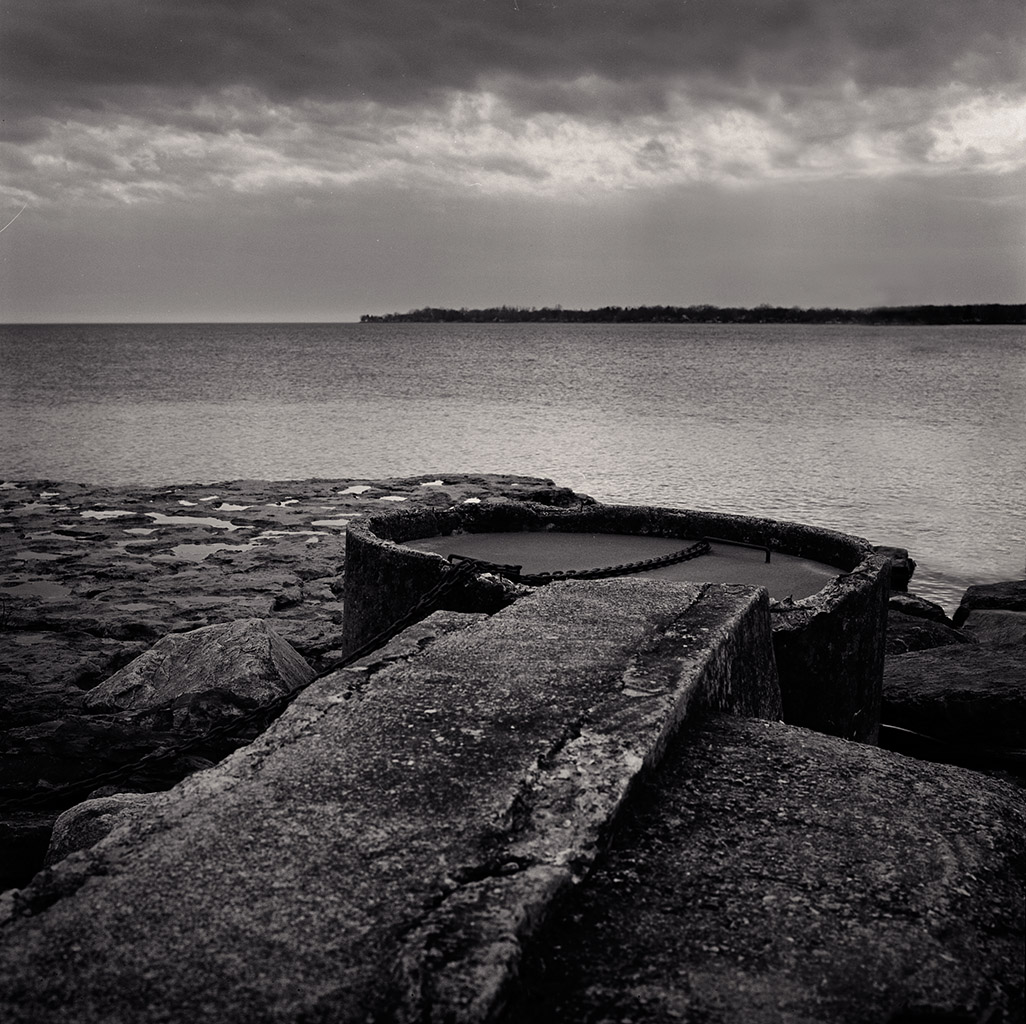
Here's a lovely little image taken from a rocky beach along the shore of Lake Erie that I had such high hopes for. It had been a bland day up to shortly before this image was taken, the textureless overcast of morning having gradually given way to a cloudless blue above without even that brief transitional play of cloud and light to provide visual interest to anything above the horizon line. It was only by virtue of a long standing inability to learn when to give up that I was still out there at all when a lucky cloud bank rolled in, providing about a half hour or so the conditions I'd been wanting for all day. In that time I fired off the remaining half of the roll I had been working with all day to that point and made a fair start on another. The entire day of wandering aimlessly with a camera had been worth it after all.

Or so I had every reason to believe up until the moment, later that evening, when I pulled the roll off the developing reel in order to hang it to dry. It was only then that I learned the sad truth, a truth that means, lovely as this image may seem at first glance, it will never see the light of... well, an enlarger lamp. Things are not as they appear here.

You see friends, the lake is a lie. What you see is the result of a not particularly meticulous Photoshop rescue of a painfully ruined image, unrescuable by standard analog means. Worse, it is the result of problem that affected exactly those images that were taken during that half hour I thought had been the day's salvation.

Here is the photograph I actually took...


The culprit... a piece of plastic film that formed part of the light trap for the dark slide slot of the film magazine. I would assume that on inserting the dark slide I had pushed it loose so that it jutted into the image area, where it appeared on all subsequent exposures until I discovered the problem. Not wanting this to be a total loss I spent about a half hour fooling around with the rubber stamp tool, magic healing brush and the like until I convinced myself I had something passable enough for the casual once over the image would get when posted online. Knowing the truth of the matter though I don't imagine you'll have much trouble spotting the flaws. I haven't had the heart to tackle several other hoped for masterpieces that were similarly ruined.

Once the problem was known I was able to take the film magazine into the darkroom and by feel find and extract the offending piece of plastic without even having to sacrifice the remaining exposures on the film which all came out fine (though honestly I just blew off the rest of the remaining frames on some so so images for fear that, if there were light leaks, I'd care about the images that were wrecked). Despite the damage the light trap has never the less performed adequately since with no hint of darkening along the edge of the two rolls that have gone through since. I was fortunate that a quick search turned up a fellow who sells complete light trap kits online, not just the foam but the little Mylar bit that came loose in my case. It arrived the other day but will have to wait until the next roll is through to be installed. If I hadn't found that neat solution I also found a DIY alternative suggested in a few online forums involving cutting a substitute plastic film literally out of film using the exposed and developed leader end from a 35mm roll, the part that usually gets cut off and tossed once the film is dry. It's a good idea to file away for the future - there's no guarantee ordering one will be so simple next time I need to redo the light trap. 

Arguably if I spent more time on this I could get a nearly flawless image, indistinguishable for all intents and purposes from what I would have come away with if that little piece of plastic hadn't come loose in the first place. I've spent far less time on this, after all, than I would normally invest making a decent darkroom print from a good negative. In theory a digital negative could then be made and contact printed in the darkroom yielding a traditional silver print. Don't look for it to happen though. It's not that I'm some some sort of purist, I have no principled objections. I just don't see myself ever having the motivation. There's plenty of other good images I could be printing. Why fake the lake?

The good news? That concrete drain looks like it's been there for a while. It will probably be there just the same when I go back, film magazine intact this time.

Thursday, 31 March 2016

A winter of... meh

Taken with the Bronica S2a with a 75mm Nikkor-P lens with an orange contrast filter on Ilford HP5 Plus.
Last year I wrote at length of my photographic revelry during the winter of 2015, a year in which Lake Erie came very near to freezing over completely. I noted how winter, at least at my latitude, can transform a landscape that was feeling a bit photographed out into something altogether fresh, and how I was therefore looking forward to what the winter of 2016 would bring. Well, it looks like for the most part El Niño put the kibosh on that idea as Winter really only put in a few token appearances this year. 

I was perhaps being a bit too optimistic in my hopes that this year would be anything like last. El Niño aside the consistently frigid temperatures of the previous year certainly seem to have become more the exception than the rule these days. But although the ground remained conspicuously un-snow-covered much of the time, there were still those token appearances, temperature drops lasting the better part of a week that, while they were too brief to produce the grand ice desert landscapes of the previous year, did bring about a few situations that wouldn't occur at any other time of year.

Case in point is the image up top. The glazed structure in question is part of concrete remains of the long abandoned Erie Beach Amusement Park that is my default destination when I'm not up for a drive out of town and don't have any better ideas. The doorway here leads into a sort of concrete room of sorts that served who knows what purpose back in its day, which is at one corner of a sort of sea wall that encloses about a hectare now overgrown with trees and cat-tails for, again, who knows what purpose. On brighter days it's possible to see to the bottom of this "room" to a floor of rocks and broken concrete, along with the occasional beverage containers and other artifacts suggesting periodic exploration by those presumably much younger than I. Photographically it's always been a bit of a challenge to me in that it seems like something that should be more interesting than any of the images of it I've come away with.

On this day however the combination of strong winds and a particularly brutal (at least in context of this winter in general) snap of cold had transformed its gratified concrete walls into something other-worldly.  In a colder year in fact it's something that wouldn't have happened at all as it wouldn't have been possible for the wind to spray the surface with water, which then froze, had the surface of the lake been frozen over. Those wild conditions had happened the night before. Things were nice and calm the next day when I got there, a few somewhat eerie clouds having moved in to compliment the mood. As you can no doubt guess rendering them as such required no small amount of burning in, accomplished here via Photoshop as the darkroom has become temporary storage through the winter while work has been going on elsewhere in the house. I'm guessing this is something a lot of home darkroom practitioners out there would relate to.


If the story of cold combined with strong winds on Lake Erie coating things with ice this passed winter sounds familiar it may be due to an image that widely circulating around the internet last January depicting a car frozen in place and completely covered over in a layer of ice. This happened in Buffalo NY, just across the way from me and, surprise, was the result of the same set of circumstances that gave that car its frosty coating. I somehow doubt that my image will make its way around the internet to the same extent. It's a shame too because, while I'm admittedly biased, I think mine is the better photograph.

Monday, 14 December 2015

One Subject, Many Approaches II

The Wall and The Bright Side of the Moon

This past summer I wrote a post called "One Subject, Many Approaches" where I looked back on the results over the years of my efforts to photograph the same subject I'd photographed many times in the past, all the while trying to keep the images fresh enough to avoid the creative dead end of making essentially the same photograph again and again. In this sequel episode I'll be presenting another one of those well worn subjects I keep returning to. It is the crumbling remnants of a concrete break wall that once helped still the waters for revellers at the long defunct Erie Beach Amusement Park. Now if that sounds a bit familiar it's likely because the original One Subject, Many Approaches centred on another ruin, the concrete base of a carnival swing ride, from that very same attraction of yore. It is just a quick jaunt, about 300 metres, from this disintegrating nautical structure that is the focus of today's episode, and it wouldn't be at all unusual for me to come away from a little afternoon stroll with images of both. 

Proximity aside however the number of appearances these two subjects have made in my photographic corpus can be attributed to two simple virtues both posses - I find them interesting, and they are convenient. If I only have an hour to kill, if I'm testing new equipment, if there's interesting weather or lighting conditions that could disappear anytime and I need to find a subject now, I know I can get something if I take the five minute drive to old Erie Beach. Still, it's hard to shake the notion that it's really too easy, an almost guilty sense that another trip out to the wall somehow falls short of doing something photographically worthwhile. In spite of this, I often come away with results that surprise me a little. Maybe it's just the low expectations I have for the results.

Here is one from my early days with the RB67, a time when I was still a bit giddy to finally own such a camera. I was smitten with the works of a host of photographers known for their work with long exposures. Lacking a proper neutral density filter at the time I would set up in the fading light of dawn when, if I timed it right, I might be able to make two or three exposures with shutter speeds of one then two then several minutes before they finally became unworkably long.

My first experimental roll putting 35mm film through the RB67, yielding panoramic sprocket hole images. Obviously I wasn't so careful levelling the camera but tilt the film a bit and it almost looks like I meant to do it that way.

An example of the classic leading off to the horizon composition I see as a metaphor for our ceaseless journey into an unknown future that beacons us to a destiny at once fearful and full of promise. Others have suggested images like this are straight up phallic. Hmpf... Freud.

Here's one from this past October that I could have included a few episodes back in The Cool Colours of Autumn. Not a great success but I was just a tad too late to catch just a brief few seconds when the setting sun burst through the clouds casting the wall in a bright warm glow. Even though I had the F80 set to auto focus aperture priority, by the time I realized what was going on and managed to compose this shot it had all but faded. 


There were days this year when water levels in the lake have been unusually high, the changing water levels at times seeming quasi-tidal.  Here a driftwood log serves as foreground interest as the wall, nearly level with the waves, is barely noticeable. There was a workman from the town at the beach that day who, seeing me pull out the camera informed me that I was too late, that there had been a rainbow out over the water that had faded away only minutes before. Looking at that cloud I can't I've lost that much sleep over not having arrived earlier.

Finally here's one from my most recent roll out of the Bronica S2A. Obviously water levels were much lower this time and I decided to chance a stroll along the wall itself. I had been out exploring new locations but with a bit of time yet to kill made a quick side trip on the way home to blow off the last few frames on the roll. Figuring I would travel light that day I left the tripod at home, an unusual choice for me. Regrettable as I could have used it here. With the short days the late afternoon sun was already beginning to fade on an already bleak day and shooting hand held forced a shutter speed/aperture trade off I just couldn't get the better of and I wound up sacrificing foreground sharpness I would have sooner kept. Negotiating the crumbling sections of the wall is a bit tricky to begin with and doing so with a bag containing prized cameras and lenses always feels like a calculated risk, It looks like I may have to do it again though.

Saturday, 5 December 2015

December


Let's play a word game. I say "December" and you think...

Okay, I don't know what you think but no matter where in the world you live or what your background is a pretty good bet would be it involves some sort of holiday celebration. And somehow it's become a widely accepted notion that a winter wonderland theme goes along nicely with holiday festivities. This can even be seen in parts of the world where, not only is snow unheard of in winter, but where the holidays actually mark the start of Summer. But while it's all well and good to spend a December afternoon at an Aussie beach sporting a Santa hat, here in Canada where the whole wintery theme is a bit more realistic there's a sense that the true holiday spirit can't be felt in earnest until there is a covering of snow on the ground. It's been noted time and again that a good pre-Christmas snowfall, something that should be an impediment to shoppers, are accompanies by a spike in holiday sales figures. Like so many others I've been guilty of worrying over whether it will be a white Christmas.

Why "guilty" though? After all, it's such a heart warming image, the world all covered in a frosty virgin white blanket, the multicoloured glow of holiday lights shining through, the neighbour's kids waving as they pass by, toboggans in tow. I say guilty because it's one more way in which the anticipation of something hoped for can make us overlook the blessings of what is right in front of us. Once the riotous colours of autumn begin fading to a dull brown it seems our thoughts skip ahead in anticipation of the (at least where I live) hopefully snowy holiday season to come. Until it arrives it seems so many of us are just biding time, getting shopping done so we can enjoy the season once it starts in earnest. Autumn may be a single season on the calendar but in these temperate climes there is no mistaking its later days from that time of peak foliage colour that gets so much attention. And two thirds of December, after all, consists of late autumn. That may of course have little to do with when the snow actually begins to fly, but depending on when (or even if) it does, much of December sometimes can feel disappointingly just not sufficiently holidayish enough.

It can be a shame because if you take away the omnipresent and not exactly subtle proclamations of the festive holiday season the month is supposed to be building towards and we might begin to notice December's pre-winter, absent the glitter and the lights, has a character and a soul of its own. It's in the skeletal forms of trees, the low hanging sun, the sombre silence of a still day. And then of course there's the autumn clouds you may have heard me go on about before.

If you're a photographer, letting any season pass without exploring its unique character would be like travelling somewhere new and interesting, somewhere you may never be again, and neglecting to get out your camera. But even when you're not carrying a camera, or if you're not a photographer at all, it's worth while, as a simple act of mindfulness, to take in what this time of year offers us in its own right. This is a time of winding down and of renewal. It can be quiet, reflective, maybe even a bit sombre. With so all of the other in-your-face goings on in December why not welcome the reprieve?

Sunday, 22 November 2015

Abstract


When I was posting the above image on my Flickr page the other day I stopped myself short of tagging it with the term "abstract". In practical terms it was a good tag to use, a word a lot of people might search on, drawing more eyeballs to my image. It made me uncomfortable though, so that even after I finally decided to use it I went back and took it out. Heaven forbid I do anything myself that might lend credence to a photograph, one I took no less, being referred to as "an abstract."

 Before you jump to any conclusions though let me hasten to add that that "abstract" is not something I find objectionable or in any way wish not to be associated with my work. Quite the opposite. What bothers me is that when a particular image is deemed to be "abstract", especially "an abstract", the implication is that it possesses some quality that distinguishes it from all those other images that aren't abstract. The problem is there are no such photographs. If I could point to a single realization I've acquired over the years that is most critical to who I am as a photographer today it is the understanding that when I make a photograph, especially one with any sort of expressive intent, abstraction is, without exception, the whole point. That point only gets lost when the term is used to single out only some images from all the rest.

To be clear here I'm not imagining that acquired any special talent that allows me imbue my work with some subtle abstract quality that I'm surprised others don't see. What I'm suggesting applies equally to anyone who has ever made a photograph whether or not they had any notion of this. While this may not be of much interest to those who do photography practical documentary purposed, but even here images are occasionally seem to posses a compelling visual appeal purely by accident. The reason is simple, a camera is a tool of abstraction, that's what it is, that's it's very nature. In short, if it's a photograph, it's abstract.

By this point I am imagining most if not all of you are thinking something along the lines of "But that's ludicrous. I know what abstract art is and that beautiful shot I took of my nephew standing by the window that everybody loves so much is not it!" So if you are thinking something along those lines, given that we're all intelligent, reasonable people here, it's probably safe to assume that I'm not using that word abstract in quite the same way you are. If this were a mere semantic quibble though I'd have done you a disservice allowing you to read as far as you have. The understanding I've come to of that word abstraction though is how I make sense of the fact that the some of the most mundane sights, things you might have passed right by and never even thought to cast a glance towards, perhaps a row of dishes drying on a rack or a clump of trees lying across a soggy field of barley, can become the subjects of photographs we find absolutely captivating. Not incidentally I also find it immensely helpful in the way I understand and approach my own work. When you're trying to make a interesting photographs it can't hurt to have an idea about what it is about photographs that can make them so interesting. If you have a notion to read on then I'll try to make it worth your while.

First, let's talk about the way the word abstract is usually used with reference to art. I think it would be fair to say that whatever the particular usage it is meant to convey a sense of the intangible. We might call the work of a surrealist like Dali abstract because what it depicts defies our sense of how we've come to understand how the world works. Or it could be used with reference to "installation art" such as that pioneered by Marcel Duchamp who used very concrete objects to represent and invite the contemplation of abstract concepts. Perhaps more than anything however it calls to mind non-representational art epitomized by the work of Jackson Pollock whose expressive paint dripped canvases bear no relation or resemblance to anything found outside the world of the psyche. All are abstract, certainly, in obvious though different ways.

The only trouble with this in my view is that when a painting, photograph or any other piece of art is only referred to as abstract when it incorporates some unusual element of abstraction that makes it stand out the message is that when art doesn't have these elements the word abstract doesn't apply. The reason that's not trivial is that it can keep us from appreciating how the element of abstraction is at play throughout all art. As I see it, it is the very essence of art. So how can we ever understand art if we think the word only applies when, for example, a painter is attempting to depict a state of mind without reference to some external "thing"?

Having said that let me take a moment to reel things in a bit. I'm a photographer, this is a photography blog so let's get back to talking about photography more specifically. To me the central mystery of photography and why I even bother with it boils down to the following question:
 How is it that, finding myself before some rather pedestrian scene or object, something I might otherwise have walked right by without a thought, point a camera at it, trip the shutter and end up with something beautiful and engaging enough to want to hang on my wall so I can look at it everyday for years? 
Objectively that thing on the wall is just a pale reflection of whatever it was that I photographed in the first place. To start out with it's been removed from the context of its surroundings to be confined within the rectangular borders of a print. There's no motion, no depth, no hint of the sounds or smells that were present when it was taken. If it's a photograph I made chances are very strong even the colour has been left behind. Given that the thing photographed was often not worth a second glance to begin with this whole endeavour sounds like a profound waste, a good quantity of time material of effort gone to take something that may not have been all that interesting to start and make it even less so.

Except that it isn't. A photograph can be so much more than a poor substitute for the thing photographed, a mere memento. It can become a new thing entirely, not despite the loss of context, dimension or motion but because of them. When we remove these things we make them less specific and therefore more universal. This is how that old pair of shoes in the front foyer you just haven't gotten around to throwing out yet can, when photographed, become all things that have been cast aside and forgotten about. We may not even be aware of the symbolism when we see it, but w well conceived and executed photograph can make you feel it even though those actual shoes in the foyer strike you as a pair of meaningless inanimate objects that would be cause for embarrassment if they were still laying there when company stopped by.

What has happened here is abstraction. That may not seem like it has much to do with the way we usually hear the word abstract use. Commonly understood abstract is sort of the opposite number to that which is real and concrete such that abolishing slavery is a concrete action while freedom is the abstract notion behind it. Fair enough, but it doesn't really help much with our understanding of how a photograph of a thing can possess engaging qualities that even the thing itself lacked. For that I want to go a bit deeper at what that word I keep batting around, "abstract", means more generally. It's comes from the Latin "abstractus" meaning drawn or pulled away. It would have been used mainly to describe some sort of material process such as separating, or drawing away, the wheat from the chaff, the metal from the ore and so on. More simply it means to take a pile of stuff that is a mix of things you want and things you don't, pull away only bits you're after, and leave the rest behind.

Now as a photographer, if you hold it in mind that this is what abstract means you'll see at first that it's a process that's at play in every photograph you've ever made or ever will make. On a foundation like this it now becomes simple to understand how all of the camera's inherent limitations - the way it flattens a three dimensional scene, severing its connection to limitless surroundings to imprison it within a tiny rectangle, all motion arrested, all sounds silenced - these are not limitations at all but the source of its power, the means by which we draw the photographic wheat from the chaotic chaff of the world around us.

I believe any photographer possessing even a modest talent will have some intuitive sense of all this, and even if they go on to great mastery may never put their now highly developed sense into these terms. When we reserve the word abstract denote only work of a more experimental nature the developing photographer (i.e. any photographer not on their death bed) is left to grope in the dark on their own for this understanding. Nor is it enough to save the word to mean "especially abstract" or "abstract in an unusual way". For example, photography has been called an "art of subtraction", where subtraction means something very close to what I mean by abstraction, so why don't I just say subtraction and leave those who want to talk about abstract photography as a special category alone? The answer is that used this way the new word "subtract" in no way fails to apply once we start talking about the things people like to refer to as distinctly "abstract", such as an image in which we have subtracted the cues that normally allow us to clearly identify the subject, thereby introducing one more abstraction.

The problem isn't the choice of terms, it's that we're trying to use terms to draw a distinction between things for which no fundamental distinction exists. Pretending they do only obscures things more, stifling our understanding along the way. The kinds of abstraction we use - the more abstract black and white rather than colour or more abstract still photography rather than motion pictures - are creative choices and asserting that the choice to photograph the more abstract distorted reflection of a subject (thereby creating "an abstract") rather than shooting it straight on is somehow different in kind from all the other choices does nothing but put up additional barriers to understanding.

And if the word abstract makes you a little uneasy because you fancy yourself someone who goes for literal interpretations in photography, remind yourself that, in photography especially, the idea of being fully literal and the idea of interpretation are inevitably at loggerheads. As is true with so many things, in photography abstraction is inevitable. Learn to embrace it, to use it. It will bring you greater understanding and make you a better photographer. And if you're not sure how, imagine yourself standing in front of a print by a one of the great photographers who's name you would never think to associate with the idea of "abstract photography". Let's say it was Ansel Adams, and he was standing there with you so you could ask him how it was made. I don't know what his real answer would have been, but a perfectly true and valid answer could be... "I simply cropped away, desaturated and tonally compressed everything that wasn't Moonrise Hernandez."

See... abstract.


Saturday, 14 November 2015

The Cool Colours of Autumn


It's perhaps only a small irony that we connect autumn, a season of cooling, with a palette of such warm colours as the green canopies above transform, taking on colours of flame which, even as they fade leave us with a warm earthy browns. I happen to be particularly fond of warmer tones;  I tend to favour them when making home decor choices, generally prefer my black and white prints to have a somewhat warmer than neutral tone to them and when I load up with colour film as I am wont to do each fall I imagine filling them with images dominated by warm earthy tones.

Often they are, but I'm often surprised myself at how often it's just the opposite. You may have noticed for example that the photo that accompanied "A Season for Colour" a few episodes back may have featured a small stand of trees with leaves in full yellow autumn glory, but these really provided a complimentary accent to the foreboding sky that occupies most of the image space with it's cool blue, tones that seem to speak of the months to come once the snow begins to fly. These aren't the images even I usually envision when I head out to do colour work at this time of year.

To me it seems this is a simple consequence of a being a predominantly black and white photographer with leanings toward the foreboding and moody set loose on the world with a colour emulsion. It's not that find myself ignoring what's in the camera and approaching what's in front of me the same way I do with the usual monochrome stock loaded. Except for those times when I may grab a camera on the way out the door to do other things I'm not committed to colour. There is always an extra film back in the pack when I carry either the Mamiya or Bronica system loaded with HP5+ or Acros and whenever a photograph to be made calls out for it, a not infrequent occurrence, I'll happily make the switch. I have to say there I rarely find myself in doubt as to which is called for, though there are situations when it seems either could work.

The image at the top is an example of this. Had I been shooting exclusively black and white that day I probably would have shot it more or less the same way. As it happens this was taken the same day I was testing out the Polaroid Automatic 220 that I wrote about previously. What I didn't mention there was that on that day a wicked wind was blowing up a minor havoc along the lake. As I emerged from the relative shelter of the nearby wooded path a few small breaks in the cloud was letting through the first rays of direct sun I had seen all day bringing a welcome drama to the wind whipped seascape. I was able to grab a Polaroid shot right off but the fast moving clouds meant I had to wait for another shaft of sun to bring the drama back again so I could get another shot with the Bronica. Good thing I did too because as fate would have it about 1/3 of the previous image I had done with the Polaroid ended up appearing in this exposure. Despite the distinctly un-autumn-like colour palette I think the sombre sky, weathered reeds and blustery weather so typical of this time of year make this an appropriately seasonal colour image.


One more example is this recent shot of my son Brennan. It was a bit of a side jaunt to the beach I took him on while running a few errands. Noting some rather interesting clouds before we left I grabbed my Nikon F80 on the way out the door. I can't say I was really planning to use him as a subject, but somehow he just belonged in the scene so how could I not? Now someone may prove me wrong, but I don't think too many would argue with the suggestion that it just wouldn't work the same way if he'd been wearing, say, a red hoodie. And though, yet again, the predominantly cool blue tones here hardly scream out autumn, despite the lack of any real queue I can point to here that gives away the fact that is image was taken in October rather than, say April, somehow there's still a sense of the season here. Maybe it's just me, because I know, because I was there. Maybe it's something else though, something about the lake, the clouds, the play of light. There are always things that can't be put into words. If there weren't we probably wouldn't bother with pictures.